K-12 Security and Surveillance Trends Shaping 2026

Security and surveillance trends in 2026 reflect a major shift in how K-12 schools and districts approach campus safety, operational visibility, and coordinated response.

Surveillance is no longer limited to cameras recording activity for later review. School districts are investing in connected environments that improve real-time awareness, strengthen emergency coordination, and support safer daily operations across campuses, administrative buildings, athletic facilities, transportation hubs, and district-wide environments.

For school leaders, facilities teams, and safety administrators, the conversation has shifted from standalone equipment to integrated infrastructure, operational intelligence, and centralized visibility. Districts are increasingly evaluating how surveillance systems support not only security goals, but also operational continuity, communications coordination, infrastructure resilience, and long-term modernization planning.

The schools making the biggest progress in 2026 are treating surveillance as part of a broader campus safety ecosystem rather than an isolated technology purchase.

Why K-12 Security and Surveillance Are Evolving in 2026

School environments are becoming more connected, district operations are increasingly distributed, and safety teams are being asked to manage more responsibilities with limited staffing and tighter operational demands.

At the same time, the risk landscape continues evolving. Schools must address physical security concerns, communication challenges, cybersecurity exposure, visitor management, and emergency coordination across multiple campuses and facilities.

Modern surveillance systems now operate alongside access control, emergency communications, environmental monitoring, and cloud-connected infrastructure as part of larger operational ecosystems designed to improve coordination and response.

This shift is changing what districts expect from surveillance technology.

Instead of simply asking whether schools have camera coverage, administrators are asking:

  • Can we improve visibility across multiple campuses?
  • Can security teams identify incidents faster?
  • Are systems connected during emergencies?
  • Can district leaders monitor environments remotely?
  • Does infrastructure support long-term modernization?
  • Are safety systems helping operational coordination, not just recording events?

These changing expectations are driving broader security industry trends focused on centralized visibility, integrated workflows, and scalable infrastructure rather than disconnected devices and siloed platforms.

For many districts, modernization is also being driven by operational realities. Aging systems, fragmented infrastructure, inconsistent camera coverage, outdated communications platforms, and disconnected security technologies often create visibility gaps that slow response and complicate investigations.As a result, K-12 organizations are prioritizing infrastructure strategies that support coordination, resilience, and district-wide oversight.

AI Surveillance Is Improving Campus Awareness

security and surveillance trends img3
K-12 Security and Surveillance Trends Shaping 2026 6

One of the most important surveillance technology trends entering 2026 is the growing use of AI-assisted video analytics in K-12 environments.

Modern AI-enabled systems help schools surface relevant events faster while reducing the burden of constant manual monitoring. Rather than requiring administrators or security personnel to review hours of footage, analytics tools help prioritize activity that may require attention.

How AI Analytics Support Faster Response

AI-assisted surveillance can help districts identify:

  • Unauthorized after-hours campus activity
  • Perimeter movement near restricted areas
  • Entry-point activity and visitor flow
  • Unusual behavior patterns
  • Safety concerns in hallways or gathering spaces
  • Vehicle activity around drop-off and pickup areas
  • Movement in restricted operational zones
  • Crowd congestion during events or dismissal periods

For many districts, AI is becoming less about automation hype and more about improving situational awareness and supporting faster decision-making during incidents.

This is particularly important for districts overseeing multiple schools where limited staffing can make constant monitoring difficult. AI-assisted workflows help direct attention toward prioritized events while reducing unnecessary operational noise.

However, AI analytics are only as effective as the infrastructure supporting them. Camera placement, lighting conditions, network performance, and system integration all affect reliability and operational usefulness.

The most effective deployments treat analytics as a decision-support layer that helps school personnel focus attention more efficiently while maintaining human oversight and operational control.

Common AI Surveillance Applications in Schools

Districts are also becoming more strategic about where AI delivers the greatest value. Rather than deploying analytics everywhere, many schools are prioritizing high-impact environments such as:

  • Main entrances
  • Parking areas
  • Athletic facilities
  • Transportation hubs
  • Restricted operational areas
  • Shared gathering spaces

In 2026, the focus is shifting from feature-heavy marketing claims toward practical workflows that improve response coordination, visibility, and campus awareness.

Cloud-Based Video Surveillance Continues to Expand

security and surveillance trends img2
K-12 Security and Surveillance Trends Shaping 2026 7

Cloud-connected infrastructure remains one of the defining video surveillance trends of 2026.

School districts managing multiple campuses increasingly rely on cloud or hybrid surveillance environments to improve centralized visibility, remote management, and operational consistency across schools.

Benefits of Cloud-Connected Surveillance

Cloud-connected platforms can help districts:

  • Manage multiple campuses from centralized dashboards
  • Improve visibility across district facilities
  • Simplify software updates and maintenance
  • Support remote administrative oversight
  • Expand infrastructure more efficiently
  • Standardize security operations district-wide
  • Improve coordination between schools and district offices
  • Reduce dependency on isolated on-site systems

For districts operating aging infrastructure, cloud-connected platforms also provide a more flexible path for modernization without requiring a complete system replacement all at once.

Districts evaluating long-term modernization strategies can also reference this K-12 School Surveillance Procurement Guide for 2026 for deeper guidance around camera categories, storage models, infrastructure planning, and district-wide surveillance deployment considerations.

Why Hybrid Infrastructure Remains Important

Hybrid environments continue gaining traction because they balance centralized management with local reliability, bandwidth efficiency, and operational resilience. Many districts are adopting phased approaches that combine local recording infrastructure with cloud-based visibility and management capabilities.

The conversation in 2026 is no longer cloud versus on-premise. District leaders are focused on building surveillance architecture that supports scalability, continuity, and coordinated campus oversight.

As schools modernize their video surveillance infrastructure, connected systems are increasingly supporting both campus safety and operational continuity.

Cloud-connected systems also support stronger district-wide standardization. Security leaders can apply policies more consistently across campuses while improving oversight for investigations, incident review, and operational monitoring.

Integrated Campus Safety Platforms Are Replacing Disconnected Systems

Another major security and surveillance trend shaping 2026 is system integration.

Schools are moving away from fragmented environments where cameras, communications systems, alerts, access control, and infrastructure operate independently.

Disconnected systems create operational friction. Investigations become manual, communication slows during emergencies, and visibility gaps emerge between departments or campuses.

Integrated platforms improve coordination by allowing technologies to share information and support faster response workflows during incidents or operational disruptions.

This integrated approach can help districts:

  • Improve emergency coordination
  • Reduce response delays
  • Centralize oversight across schools
  • Improve communication between departments
  • Simplify investigations
  • Strengthen district-wide operational visibility
  • Support coordinated response workflows
  • Improve operational consistency across campuses

Emergency Notification Integration Is Expanding

Modern emergency notification systems are increasingly integrated with surveillance and communications infrastructure to support faster campus coordination during emergencies, severe weather events, operational disruptions, and safety incidents.

For K-12 districts, surveillance strategy is increasingly tied to broader campus safety planning. Schools are prioritizing centralized visibility across multiple buildings, faster coordination during emergencies, and integrated systems that connect surveillance, communications, access control, and operational response workflows.

This convergence is especially important for larger districts operating multiple schools, transportation facilities, athletic complexes, and administrative offices, where consistent coordination is critical.

Integration also helps reduce operational silos between departments. Security teams, facilities personnel, district administrators, and IT leaders increasingly need shared visibility into infrastructure and operational environments.The trend is clear: districts are prioritizing connected ecosystems over isolated technologies.

Cybersecurity Is Becoming Central to School Surveillance Planning

security and surveillance trends img4
K-12 Security and Surveillance Trends Shaping 2026 8

As surveillance systems become more network-connected, cybersecurity is becoming a larger part of K-12 safety strategies.

Cameras, cloud-managed platforms, access control systems, remote management tools, and communications infrastructure all introduce potential exposure points that districts must secure carefully.

As schools continue expanding connected environments, cybersecurity concerns are becoming part of routine infrastructure planning rather than separate IT discussions.

In response, districts are placing greater focus on:

  • Secure network architecture
  • Device management policies
  • Infrastructure segmentation
  • Access governance
  • Firmware management
  • Platform interoperability
  • User authentication controls
  • Remote access security

Physical and Cyber Security Are Now Interconnected

District leaders increasingly recognize that physical security and cybersecurity cannot operate separately. Infrastructure resilience now depends on how effectively schools align both strategies within connected campus environments.

This shift is also influencing procurement decisions. School leaders are paying closer attention to long-term infrastructure compatibility, platform integration, lifecycle management, and operational support rather than evaluating devices in isolation.

Cybersecurity planning is becoming especially important as districts adopt more cloud-connected infrastructure and remote management capabilities across distributed campuses.

Surveillance Is Becoming Part of Broader Operational Infrastructure

Another important trend shaping 2026 is the growing role surveillance systems play beyond traditional security functions.

Districts increasingly use connected surveillance environments to support broader operational awareness, facility coordination, and infrastructure management across campuses.

This includes visibility related to:

  • Visitor movement
  • Transportation operations
  • Facility access activity
  • Building usage trends
  • Operational coordination during events
  • Shared campus environments
  • After-hours facility monitoring

For larger districts, surveillance infrastructure is becoming part of a broader operational ecosystem tied to communications, safety planning, facilities oversight, and continuity strategies.

Similar visibility and coordination challenges are also shaping surveillance modernization in manufacturing and warehousing environments, where distributed operations require centralized oversight.This shift reflects a larger industry movement away from isolated physical security tools toward connected operational infrastructure that supports both safety and day-to-day coordination.

What These Trends Mean for School and District Leaders
security and surveillance trends img5
K-12 Security and Surveillance Trends Shaping 2026 9

The districts gaining the most value from security investments in 2026 are focusing less on individual devices and more on long-term infrastructure strategy.

Instead of asking which camera has the newest features, decision-makers are evaluating:

  • Whether systems integrate effectively
  • How infrastructure scales across campuses
  • Whether teams can access centralized visibility
  • How quickly incidents can be identified and coordinated
  • Whether infrastructure supports future modernization
  • How security systems contribute to safer daily operations
  • Whether platforms improve operational continuity
  • How effectively communications and surveillance work together

Budgeting strategies are evolving as well. Districts are increasingly prioritizing scalable platforms, lifecycle planning, and infrastructure alignment instead of isolated hardware purchases that may create future compatibility issues.

District leaders preparing for upcoming modernization and procurement cycles can also reference this K-12 School Surveillance Procurement Guide for 2026 for deeper planning guidance around camera categories, storage architecture, AI analytics, cybersecurity considerations, and multi-campus surveillance strategy.

The broader trend is clear: surveillance systems are increasingly being evaluated as operational infrastructure rather than standalone security equipment.Schools that prioritize integration, visibility, resilience, and scalable infrastructure will be better positioned to support safer campuses as security and surveillance trends continue evolving throughout 2026 and beyond.


Cyber Threats Facing Mid-Market Companies

Mid-market organizations are navigating a rapidly evolving digital landscape. Cloud adoption, remote access, SaaS platforms, and connected operational systems have accelerated efficiency and growth.

They have also introduced new exposure.

Understanding the cyber threats facing mid-market companies is no longer just an IT concern. It is a business priority tied directly to uptime, customer trust, regulatory posture, and long-term scalability.

For many organizations, the question is not whether they will be targeted. It is whether they are prepared when it happens.

Why Mid-Market Organizations Are a Prime Cyber Target

Mid-market organizations occupy a strategic middle ground in today’s threat landscape.

They are typically more digitally mature than small businesses, with multiple locations, hybrid workforces, cloud-based systems, and integrated operational technology. Yet they often lack the dedicated security operations centers, in-house threat analysts, and layered defense models of large enterprises.

Attackers understand this imbalance.

Cybercriminal groups target the middle market for scale and efficiency. A successful breach can generate significant financial return, while defenses may be less mature or inconsistently managed.

At the same time, digital transformation has expanded the attack surface. Remote access tools, vendor integrations, mobile devices, and cloud applications create additional entry points. Security maturity often lags behind infrastructure growth, especially during periods of rapid expansion.

Organizations working with partners like Eastern DataComm often discover that growth initiatives unintentionally introduced risk that was never fully assessed.

The Most Common Cyber Threats Impacting Businesses Today

The most common cyber threats to businesses today are rarely dramatic at the outset. They begin quietly and escalate quickly.

Ransomware continues to dominate headlines because of its disruptive impact. Attackers encrypt critical systems, halt operations, and demand payment for restoration. For mid-market companies, even a few days of downtime can result in significant financial and reputational damage.

Credential compromise is equally dangerous. Stolen usernames and passwords, often obtained through phishing or password reuse, allow attackers to move laterally within networks. From there, they escalate privileges and gain deeper access.

Phishing and social engineering attacks target employees directly. Well-crafted emails or messages prompt users to click malicious links, share sensitive information, or approve fraudulent transactions.

Supply chain exposure is another growing concern. Third-party vendors, managed service providers, or cloud platforms may introduce vulnerabilities into otherwise secure environments.

These cyber threats facing mid-market companies do not only affect data. They disrupt workflows, disable communication systems, interrupt billing platforms, and undermine trust in digital infrastructure.

Most breaches begin with simple entry points. A compromised email account. An exposed remote desktop service. An unpatched device. Fragmented oversight and limited visibility make early detection more difficult.

How Cyber Attacks Impact Business Operations and Continuity

To fully grasp how cyber attacks impact businesses, leaders must look beyond IT downtime.

A ransomware event can shut down inventory management systems in a distribution center. A credential compromise can disable access to scheduling platforms in a healthcare facility. A phishing campaign can interrupt financial processing or payroll systems.

Operational paralysis often follows.

When digital systems go offline, teams revert to manual processes. Productivity drops. Customer service suffers. Decision-makers operate with limited or outdated information.

Cyber incidents quickly become operational incidents, especially in environments where systems are interconnected.

Without resilient and properly segmented secure network infrastructure, containment efforts can disrupt additional systems unintentionally. Recovery becomes more complex and costly.

Beyond direct financial loss, organizations may face regulatory exposure, reputational damage, and erosion of customer confidence. In many cases, recovery costs exceed what proactive investment in prevention would have required.

Cybersecurity Risks Increase When IT and Operational Systems Converge

Modern organizations are increasingly converging IT networks with operational systems.

Surveillance platforms, access control systems, building management systems, and communication tools now operate over IP-based networks. This convergence improves efficiency and centralizes oversight.

It also expands cybersecurity risks for organizations.

When operational systems rely on centralized authentication or cloud connectivity, any compromise in digital infrastructure can cascade into physical disruption. A network outage can disable video feeds. A compromised identity system can affect access permissions.

Convergence expands the attack surface and increases interdependency.

Strong segmentation, access control policies, and continuous monitoring are essential when IT and operational systems intersect. Implementing robust secure data networking practices ensures that a breach in one segment does not spread unchecked.

Cyber risk now directly influences safety, uptime, and the integrity of physical environments.

Why Traditional Cybersecurity Approaches Fall Short

Many mid-market organizations attempt to solve cybersecurity challenges by layering additional tools onto existing environments.

Firewalls are upgraded. Endpoint agents are deployed. Monitoring tools are added.

Yet more tools do not necessarily translate to better protection.

Tool sprawl creates complexity. Different platforms generate separate alerts with limited context. Teams spend time toggling between dashboards instead of analyzing meaningful insights.

Siloed security models also create blind spots. IT teams may manage network security, while facilities teams oversee operational systems, with little coordination between them.

Traditional cybersecurity approaches often focus on perimeter defense and reactive response. Once an alert is triggered, teams scramble to assess impact and contain damage.

The issue is rarely a lack of technology. It is a lack of integration, visibility, and strategic alignment.

Enterprise Cybersecurity Fundamentals for Mid-Market Organizations

Enterprise cybersecurity fundamentals are not reserved for global corporations. They are architectural principles that apply to organizations of any size.

Comprehensive visibility across networks, endpoints, and cloud environments provides the foundation for informed decision-making. Segmentation limits the ability of attackers to move laterally within systems. Strong identity and access management reduces unauthorized entry points.

Continuous monitoring and structured incident response planning ensure that threats are identified and addressed quickly.

These fundamentals scale effectively when designed correctly.

Eastern DataComm delivers enterprise cybersecurity services rooted in architectural discipline rather than tool accumulation. By aligning cybersecurity controls with operational requirements, mid-market organizations can achieve enterprise-level resilience without unnecessary complexity.

For broader organizational needs, tailored commercial cybersecurity solutions extend these principles across diverse business environments.

Architecture matters more than product selection. Security must support operations, not hinder them.

How Integrated Cybersecurity Protects Critical Infrastructure

Integrated cybersecurity brings together network infrastructure, monitoring platforms, identity controls, and physical systems into a coordinated framework.

When systems share intelligence, alerts become contextual rather than isolated. A suspicious login attempt can correlate with unusual network traffic. Anomalous device behavior can trigger deeper inspection automatically.

This integration improves detection speed and reduces response time.

Strong, secure network infrastructure ensures that cybersecurity controls operate consistently, even during periods of high demand or attempted disruption.

Integrated environments also improve recovery. Clearly defined segments and monitored systems allow teams to isolate affected areas without shutting down entire operations.

By aligning digital safeguards with operational priorities, organizations build resilience that extends beyond IT and into core business continuity.

What Mid-Market Leaders Should Be Asking Right Now

Cyber resilience begins with strategic reflection.

Do we have visibility into every device, platform, and system connected to our network?

Are remote access points secured and monitored?

If a ransomware event occurred tomorrow, could we isolate it without disrupting operations across the organization?

Are cybersecurity and physical systems aligned, or are they managed independently?

Many cybersecurity risks for organizations remain hidden until tested under pressure. Asking the right questions now prevents reactive decision-making later.

Assessment is not about identifying fault. It is about identifying opportunity for improvement.

Strengthening Cyber Resilience Across Your Organization

Resilience is not accidental. It is designed.

Strengthening protection against the cyber threats facing mid-market companies requires alignment between infrastructure, cybersecurity controls, and operational systems.

Organizations that partner with experienced security integration specialists gain strategic oversight, architectural clarity, and a roadmap for sustainable improvement.

If your leadership team is evaluating how to protect the business from cyber threats while supporting growth, the next step is structured assessment and planning.

You can request a cybersecurity consultation to assess exposure, align systems, and build a resilient cybersecurity foundation designed to support long-term operational success.

Why Fragmented Security Systems Fail, and What Integrated Protection Looks Like

Fragmented security systems develop when access control, video surveillance, communications, cybersecurity, and network technologies operate through separate platforms with limited coordination or shared data. The result can be blind spots, disconnected alerts, additional manual steps, and slower incident investigation.

As physical security technologies become increasingly connected to enterprise networks, those gaps can affect both physical and digital operations. Integrated security systems address fragmentation by coordinating technologies, infrastructure, workflows, and teams so relevant information is available when it is needed.

For a deeper look at convergence, explore our complete guide to physical security and cybersecurity and learn more about enterprise cybersecurity.

What Fragmented Security Systems Actually Look Like in Practice

Security environments rarely become fragmented through a single decision. More often, fragmentation develops over years as organizations add technologies to solve individual needs.

A facility might have one vendor managing cameras, another supporting access control, and separate providers for communications, networking, and cybersecurity. Each system may function properly on its own while relying on a different interface, database, or management process.

Problems caused by fragmented security systems become clearer when an event requires information from several technologies at once. An access control alert may not provide corresponding video. An emergency communication platform may operate independently from other security alerts. IT and physical security teams may investigate related events through separate logs without realizing there is a connection.

This is what happens when security systems are fragmented: information exists, but the context needed to interpret it is scattered.

That fragmentation can remain almost invisible during routine operations. It becomes much more apparent when teams need to investigate, communicate, and make decisions quickly.

Why Apps and Point Solutions Are Not Enough

why fragmented security systems fail img1
Why Fragmented Security Systems Fail, and What Integrated Protection Looks Like 13

Adding another security tool does not necessarily solve fragmentation. In some cases, it simply creates another interface that employees need to monitor and manage.

A single-purpose app or point solution may perform its specific task well. The problem arises when the organization expects that individual tool to compensate for weaknesses elsewhere in the security environment.

For example, adding cameras can increase visibility, but it does not automatically connect surveillance to access events. A notification app can distribute messages, but it does not necessarily coordinate with access control, surveillance, or other facility systems.

The goal should not simply be more technology. Effective integrated protection for facilities depends on architecture that allows appropriate systems, information, and workflows to work together.

Integration also does not require every system to come from the same manufacturer. What matters is whether technologies are selected and designed with interoperability, infrastructure, security, and operational requirements in mind.

What Integration Actually Changes About Facility Security

Integrated security systems change how information moves through a facility and how teams use it.

Consider an access control event at a restricted entrance. In a disconnected environment, security personnel might receive the access alert, open a separate surveillance platform, identify the correct camera, locate the relevant timeframe, and then determine what occurred. With access control integration and unified surveillance, the event can provide the context needed to direct personnel toward relevant video more quickly.

The same principle applies to emergency communication systems. Rather than relying on several independent processes, appropriately integrated technologies can support coordinated workflows and help distribute consistent information across available communication channels.

Integration also matters beyond physical events. Security and IT teams can gain better visibility into system health and unusual activity when connected physical systems are incorporated into broader monitoring practices.

The result is a more complete operational picture. Instead of reconstructing an incident from isolated systems, teams have better access to relevant information across physical and cyber environments.

The Infrastructure Layer That Makes Integration Possible

Integration depends on more than connecting applications. Cameras, access controllers, communications platforms, cloud services, and cybersecurity tools all rely on underlying network and IT infrastructure.

That makes the network a critical part of integrated protection. Surveillance can generate significant traffic. Cloud-managed platforms require reliable connectivity. Connected security devices require authentication, configuration, firmware management, and appropriate network segmentation.

Simply placing every physical security device on the same network can introduce unnecessary cyber exposure. Effective integration considers how devices communicate, which systems need access to one another, and how traffic should be separated and protected.

A properly designed security infrastructure backbone helps support the performance, availability, and security that connected systems require.

This infrastructure-first perspective is essential because even well-designed security technologies can be limited by the network architecture supporting them.

How Eastern DataComm Designs Integrated Security Environments

With more than 35 years of integration experience, Eastern DataComm designs and deploys physical security, communications, cybersecurity, and IT infrastructure solutions for organizations across the Eastern Seaboard.

Our approach begins with assessment rather than assuming an organization needs to replace everything it already has. We evaluate existing technologies, infrastructure, operational requirements, and potential gaps before developing an integration strategy.

From there, Eastern DataComm provides design, installation, integration, and lifecycle support using a manufacturer-agnostic approach. This allows existing technology to be incorporated where appropriate while helping organizations move toward a more unified security environment.

For education, government, commercial, logistics, assisted living, and other facilities, the objective is the same: reduce unnecessary silos and create technology environments that provide better visibility, coordination, and long-term manageability.

Ready to identify fragmentation in your existing environment? Schedule a security assessment with Eastern DataComm.

Building Safer, Smarter, and More Connected Communities: Eastern DataComm’s New Integrated Technology Solutions

For more than 35 years, Eastern DataComm has been helping organizations stay connected and protected. What began as a trusted provider of communication systems has evolved into a full-service technology integrator—one that designs and deploys modern IT, security, and communication solutions to meet the changing needs of schools, businesses, and municipalities across the Eastern Seaboard.

Today, Eastern DataComm is proud to introduce an expanded portfolio of solutions that brings together enterprise IT infrastructure, data center technologies, and end-user computing solutions. These offerings work hand-in-hand to create unified environments where safety, communication, and connectivity operate seamlessly under one roof.

A Comprehensive Approach to Modern Technology

In today’s digital landscape, organizations face complex challenges: aging infrastructure, cybersecurity risks, hybrid workforces, and rising expectations for uptime and connectivity. Eastern DataComm’s new integrated technology portfolio helps solve these challenges by combining secure, scalable, and easy-to-manage systems across every layer of an organization’s network.

The result? Smarter technology ecosystems that reduce risk, enhance efficiency, and empower teams to focus on what matters most—their mission.

Enterprise IT Infrastructure: The Foundation for Growth

Whether managing a multi-campus school district, a municipality, or an enterprise business, a reliable IT foundation is critical. Eastern DataComm’s Enterprise IT Infrastructure Solutions are engineered to deliver high-performance connectivity, advanced cybersecurity, and long-term scalability.

Key Capabilities Include:

  • Network Solutions: Design and deployment of enterprise LANs, WANs, and secure remote access systems optimized for bandwidth, traffic, and uptime.
  • Security Solutions: Integrated firewalls, endpoint protection, access control, and 24/7 monitoring safeguard against cyber threats.
  • Wireless Solutions: Predictive wireless design and Wi-Fi optimization for campus-wide coverage and performance.
  • Data Center Solutions: Agile and resilient infrastructure that supports cloud, hybrid, and on-premises environments.

Each element is purpose-built to work in unison, giving organizations a secure, high-performing backbone that supports every user, device, and application.

Data Center Solutions: Reliability from the Ground Up

Behind every successful organization lies a strong, resilient data center. Eastern DataComm’s Enterprise Data Center Solutions are designed to keep your systems running efficiently, securely, and without interruption.

How We Strengthen Your Infrastructure:

  • Data Center Infrastructure Management (DCIM): Real-time monitoring, predictive maintenance, and analytics to prevent downtime and extend equipment lifespan.
  • Enterprise Data Storage: Scalable, secure storage systems that protect mission-critical data while supporting growth.
  • Physical & Cybersecurity Integration: Access control, surveillance, and intrusion detection to safeguard sensitive assets.
  • Data Center Migration Services: Expert-led transitions that minimize risk, maintain continuity, and optimize performance during upgrades or relocations.

From municipal IT departments and higher education institutions to enterprise businesses, Eastern DataComm tailors every deployment to meet the unique needs of the client. Whether modernizing legacy systems or expanding to new facilities, our solutions are engineered for high availability, reliability, and compliance.

End-User Computing: Empowering the Modern Workforce

The way people work has changed—and so must the technology that supports them. Eastern DataComm’s End-User Computing Solutions enable secure, seamless access to applications and data from anywhere, on any device.

Benefits of Our End-User Computing Solutions:

  • Cloud-Based Virtual Desktops: Give staff and students secure, on-demand access to applications and files—ideal for hybrid or remote environments.
  • Centralized Device Management: Simplify IT operations by monitoring, updating, and troubleshooting devices from a single dashboard.
  • Enhanced Security: Multi-layer protection through encryption, access control, and endpoint monitoring.
  • Scalability and Flexibility: Easily onboard new users or expand operations without costly infrastructure overhauls.

For schools, this means teachers and students can connect safely from any location. For businesses, it enables employees to stay productive and protected whether on-site or remote. For municipalities, it ensures public services run smoothly and securely—every day.

Integrated Safety and IT: One Partner, Multiple Solutions

it solutions for schools businesses municipalities cont img1
Building Safer, Smarter, and More Connected Communities: Eastern DataComm’s New Integrated Technology Solutions 17

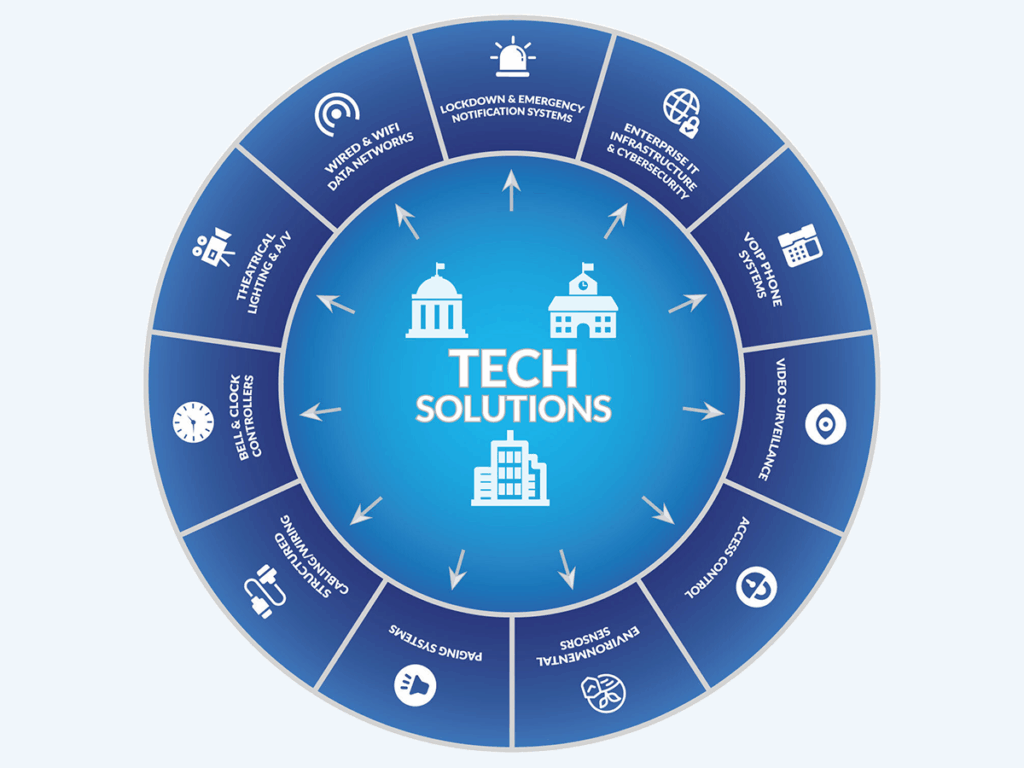
Eastern DataComm’s technology offerings are designed to work together as part of a complete safety, communication, and IT ecosystem. From VoIP phone systems and emergency notification platforms to wired, wireless, and cloud infrastructure, every system is designed with one goal in mind: keeping communities connected and protected.

With decades of experience across education, public sector, and enterprise environments, our team understands the compliance standards that matter most—such as Alyssa’s Law, NFPA 72, and NIST cybersecurity frameworks. We help ensure that every deployment not only performs but also aligns with your organization’s safety and operational mandates.

Why Organizations Choose Eastern DataComm

1. Deep Experience & Proven Expertise

With more than 35 years of success serving schools, municipalities, and businesses, Eastern DataComm brings a rare combination of technical knowledge and real-world experience.

2. Tailored, Turnkey Solutions

Every environment is unique. That’s why we take a consultative approach—assessing your current technology, identifying gaps, and designing solutions built around your needs, not a vendor’s catalog.

3. Integrated Safety and IT Expertise

Unlike providers that focus solely on networking or security, Eastern DataComm bridges both worlds—offering fully integrated solutions that unify physical safety systems with IT infrastructure.

4. Local Presence with Regional Reach

Headquartered in New Jersey and with operations spanning New York, North Carolina, and beyond, Eastern DataComm provides localized support with enterprise-level delivery capacity across the Eastern Seaboard.

5. Commitment to Long-Term Partnership

Our work doesn’t end after deployment. We provide ongoing managed services, training, and proactive monitoring through our CoreSupport™ Managed Security Services, ensuring your systems continue to perform at their best.

Serving the Eastern Seaboard’s Most Trusted Institutions

it solutions for schools businesses municipalities cont img2
Building Safer, Smarter, and More Connected Communities: Eastern DataComm’s New Integrated Technology Solutions 18

Eastern DataComm proudly supports:

  • K–12 Schools and Higher Education Institutions seeking unified safety and communication systems that protect students and staff.
  • Municipal Governments working to modernize infrastructure, secure data, and deliver reliable services to the community.
  • Commercial and Enterprise Businesses aiming to streamline operations, strengthen cybersecurity, and scale efficiently.

From New Jersey to North Carolina—and every community in between—we’re committed to helping our clients modernize safely, efficiently, and sustainably.

Building the Future of Safe, Connected Communities

In an era where technology underpins nearly every aspect of daily life, Eastern DataComm stands out as a trusted partner for organizations ready to modernize and protect their operations. Whether upgrading your enterprise IT infrastructure, migrating your data center, or empowering your remote workforce, our integrated solutions are designed to help you achieve long-term success.

Our Vision for a Safer, More Connected Future

Our vision extends beyond technology implementation—we’re helping communities build resilience, efficiency, and confidence in an increasingly connected world. By uniting physical safety systems with robust IT infrastructure, Eastern DataComm empowers schools to respond faster in emergencies, businesses to operate with greater agility, and municipalities to serve their citizens securely and reliably. Every project we deliver is guided by the belief that communication and safety are inseparable foundations of success. From modernizing classrooms and government offices to optimizing enterprise networks and cloud environments, we bring decades of expertise and a customer-first approach to every engagement. The result is more than just upgraded systems—it’s a connected security and communications ecosystem that grows with your organization and adapts to the challenges of tomorrow. At Eastern DataComm, we’re not just integrating technology — we’re shaping safer, smarter, and more connected communities across the Eastern Seaboard.

Ready to Future-Proof Your Organization?

Let’s discuss how Eastern DataComm can help you design a safer, smarter, and more connected environment.

Schedule a Security & Communications Consultation today to review your current technology and discover how we can help you save time, money, and resources—while keeping your organization protected and connected.

Safeguarding Schools, Municipalities, and Businesses: How Eastern DataComm Protects Communities from Cyber Threats

In today’s hyperconnected world, technology forms the backbone of how schools, municipalities, and businesses operate. From maintaining emergency communications in K–12 districts to managing sensitive resident data at the municipal level to ensuring operational uptime for businesses, one constant remains: the need for secure, resilient enterprise IT infrastructure and cybersecurity strategies.

Unfortunately, attackers know this too. Cyber threats are growing more sophisticated, and organizations across sectors often face resource, budget, or expertise gaps that leave them vulnerable. Ransomware, phishing, and system outages don’t just put data at risk—they can disrupt essential services, erode trust, and cost millions in recovery and downtime.

This blog explores the most common cybersecurity threats faced by schools, municipalities, and businesses, and outlines how Eastern DataComm delivers the enterprise IT infrastructure and cybersecurity solutions needed to keep communities across the Eastern Seaboard connected, protected, and future ready.

The Cyber Threat Landscape: What’s at Stake?

Threats to Schools

Educational institutions, especially K–12 school districts and community colleges, face unique challenges. With limited budgets, it can be tempting to delay system upgrades or reduce investment in cybersecurity. But schools are high-value targets.

  • Ransomware attacks: Criminals lock down systems containing student records, payroll, or even healthcare information, demanding hefty payments.
  • Phishing scams: Teachers and administrators are often targeted with deceptive emails that can lead to credential theft.
  • FERPA and HIPAA risks: Breaches put compliance and parental trust at risk.

A single compromise can disrupt learning, expose sensitive student information, and cost districts dearly in both reputation and finances.

Threats to Municipalities

Municipal governments are tasked with protecting critical infrastructure and delivering essential services. Unfortunately, attackers see them as soft targets because many local agencies lack layered defenses.

  • Data breaches of CJIS-protected systems: Compromising law enforcement or court data poses risks to public safety.
  • Disruption of emergency communications: Attacks on 911 centers or dispatch services can create life-threatening delays.
  • Public works sabotage: Cyber incidents targeting water, power, or transportation networks can shut down operations.

These attacks don’t just impact systems—they put entire communities at risk.

Threats to Businesses

Mid-sized businesses (100–500 employees) are often in the “sweet spot” for attackers: large enough to hold valuable financial and customer data but small enough to lack full-time, in-house security teams.

  • Ransomware and data theft: Sensitive financial or proprietary information is stolen or encrypted.
  • Downtime and lost revenue: Outages caused by breaches halt operations and frustrate customers.
  • Compliance penalties: Failing to meet industry requirements (PCI-DSS, HIPAA, SOX) can result in fines and reputational damage.

For growing businesses, a serious cyber incident can undo years of progress and compromise future opportunities.

Why Enterprise IT Infrastructure and Cybersecurity Go Hand in Hand

cybersecurity
Safeguarding Schools, Municipalities, and Businesses: How Eastern DataComm Protects Communities from Cyber Threats 22

Many organizations still operate on aging, fragmented networks: outdated firewalls, legacy switches, and inconsistent endpoint protections. These weaknesses create easy gateways for attackers.

Cybersecurity cannot be treated as a standalone product. Instead, it must be built into the DNA of enterprise IT infrastructure. At Eastern DataComm, we integrate advanced threat prevention, network management, and incident response into one seamless framework.

Key benefits of this approach include:

  • Business Continuity: Systems remain online even during cyber incidents.
  • Compliance Confidence: Solutions help schools meet FERPA/HIPAA, municipalities meet CJIS/NIST/CMMC, and businesses meet PCI-DSS/SOX.
  • Performance and Security Together: Networks stay fast and reliable while remaining hardened against attack.
  • Future Readiness: Infrastructure scales and adapts as threats evolve.

Eastern DataComm’s Approach to Safeguarding Communities

1. Core Enterprise Cybersecurity Services

Eastern DataComm delivers a robust enterprise cybersecurity and IT infrastructureecosystem tailored to each client’s industry and risk profile:

  • Intrusion Detection & Prevention Systems (IDS/IPS): Stop malicious activity before it escalates.
  • Data Loss Prevention (DLP): Block unauthorized transfers of sensitive data across devices and applications.
  • Zero Trust Security: Verify every user, device, and request before granting access.
  • Centralized Access Control: Simplify permissions management for schools, municipalities, or growing businesses.
  • Network Segmentation: Prevent a single breach from spreading across the network.

2. Managed Security & CoreSupport™

Not every organization can staff a 24/7 security operations center. That’s why Eastern DataComm offers CoreSupport™ Managed Security Services:

  • 24/7 monitoring with advanced analytics
  • Immediate alerting on suspicious activity
  • Automated containment to isolate compromised systems
  • Firewall management, antivirus, and endpoint protection
  • Scalable tiers to fit budgets and growth plans

For businesses, CoreSupport™ can be paired with RealCISO, a cost-effective virtual CISO platform that helps organizations measure compliance (NIST, HIPAA, CMMC, SOC 2) and prioritize improvements.

3. Enterprise IT Infrastructure and Professional Services

Eastern DataComm offers comprehensive enterprise IT professional services to identify weaknesses and optimize infrastructure:

  • Network discovery and configuration review
  • Converged network enhancement and hardening
  • Predictive wireless mapping and turnkey deployments
  • Security assessments, pen testing, and phishing awareness training

This proactive work ensures that networks aren’t only functional, but also fortified against exploitation.

4. Industry Partnerships for Best-of-Breed Solutions

Eastern DataComm partners with top technology partners who are leading innovation in industry to deliver cohesive strategies, including:

  • HPE Aruba for secure wireless and scalable networks
  • Fortinet for advanced firewalls and unified threat protection
  • Sophos for Managed Detection & Response (MDR)
  • Barracuda for cloud backup and email security
  • Cisco/Meraki for enterprise networking hardware
  • Arctic Wolf and other leaders for layered defenses

These partnerships ensure that every client’s solution is modern, reliable, and customized.

Case in Point: Safeguarding Communities Across Sectors

safeguarding communities
Safeguarding Schools, Municipalities, and Businesses: How Eastern DataComm Protects Communities from Cyber Threats 23

Protecting Schools

Eastern DataComm helps school districts deploy lockdown and emergency notification systems that work in unison with cybersecurity solutions to keep reduce physical and cyber threats. This dual approach ensures students remain physically safe during emergencies while networks protect sensitive data from digital threats.

Supporting Municipalities

From city hall to emergency services, municipalities benefit from network segmentation and continuous monitoring, preventing breaches that could otherwise shut down vital public services.

Securing Businesses

For businesses, Eastern DataComm delivers cloud security and endpoint protection. These solutions minimize downtime, protect revenue streams, and safeguard intellectual property.

The Cost of Doing Nothing

Cyber threats are relentless:

  • Ransomware attacks occur every 14 seconds worldwide.
  • Over 90% of breaches originate from phishing.
  • The average cost of downtime for mid-sized organizations can exceed $10,000 per hour.

Without proactive investment in enterprise IT infrastructure and cybersecurity, organizations risk not just technical failure but also reputational collapse and financial loss.

Why Partner with Eastern DataComm?

Eastern DataComm is more than simply a technology integrator; we are a trusted partner with over thirty-five years of experience helping schools, municipalities, and businesses across the Eastern Seaboard.

We combine:

  • Deep expertise in enterprise IT infrastructure and cybersecurity
  • Integrated safety, security, and communication systems
  • Ongoing support and consultation to keep defenses strong long after deployment

When you work with Eastern DataComm, you gain a team that understands the stakes of safeguarding communities, and delivers solutions engineered for resilience.

The threats facing schools, municipalities, and businesses are real and rising. But with the right partner, those risks can be minimized. Eastern DataComm’s integrated enterprise IT infrastructure and cybersecurity services deliver not just protection, but peace of mind.

Whether you’re responsible for protecting students, residents, or corporate assets, your mission is too important to leave to chance.

Let’s create a safer, smarter, more connected community together.

Work with our team to have your safety and communications questions answered today.

Why Fragmented Safety Systems Fail—and What Integrated Protection Looks Like in Action

Disconnected Systems, Disconnected Response

When seconds matter, fragmented systems can cost more than just dollars. They can cost lives. Many organizations, especially schools, municipalities, and manufacturing facilities, still rely on a patchwork of disconnected safety tools: standalone PA systems, legacy phone systems, outdated access control, and separate emergency notification platforms.

The problem? In a high-stress moment, these systems don’t communicate. That means slower lockdowns, missed messages, and multiple points of failure. As Len Nirchio, Senior Account Executive at Eastern DataComm, explains, “When you have multiple vendors, there may be finger pointing… but when one trusted partner wraps their arms around the whole project, you get results.”

What Integration Looks Like in Action

Imagine this: A threat is identified. A staff member picks up any phone, dials a code, and instantly:

  • The PA system activates with a pre-recorded lockdown message.
  • All doors automatically lock.
  • Swipe access is disabled for everyone except first responders.
  • Strobe lights flash to alert non-hearing individuals.
  • Emergency messages go out via text, email, and phone call.

“You don’t have to run back to the main office,” says Paul Jenne, VP of Sales & Business Development at Eastern DataComm. “You can activate the system from anywhere in the building. We extend your command center to the entire facility.”

This is what integrated safety looks like: fast, automatic, and building+grounds-wide.

At the center of many of these solutions is LENS (Lockdown & Emergency Notification System) — Eastern DataComm’s flagship tech solution. LENS is designed to automate emergency response across communication in multi-modal ways that are both reliable and fast. Whether it’s triggered from a classroom or office phone, wall-mounted panic button, or desktop interface, LENS enables precise, building-wide action within seconds.

This is what integrated safety looks like: fast, automatic, and building+grounds-wide.

new pinwheel
Why Fragmented Safety Systems Fail—and What Integrated Protection Looks Like in Action 28

How Integrated Systems Improve Budget Planning

The fear of integration often comes down to budget. Will it always require ripping and replacing systems recently purchased? Not with Eastern DataComm.

“We always ask: What can we reuse? What can we tie in?” Paul explains. “In many cases, we integrate with the client’s existing technology, saving them from unnecessary spending.”

Whether you’re working with a single-year budget or planning across multiple fiscal cycles, Eastern DataComm’s phased approach helps prioritize the most impactful upgrades first, then scales from there. This strategy not only keeps projects financially manageable, but also ensures that each stage adds meaningful value along the way.

Clients are also supported with a comprehensive Safety & Communications Audit, which evaluates current infrastructure, identifies blind spots, and lays the groundwork for a future-proof system. This diagnostic-first approach means no wasted investment—just smart, strategic implementation.

Saving Lives with Seconds to Spare

When it comes to school and organizational safety, speed is everything. Every second saved could prevent tragedy.

“Before integration, many of our clients had to manually flip switches, grab microphones, and physically lock doors,” says Len. “Now, it’s a single action triggering a unified response.”

Paul adds, “Safety is about speed of communication. You want people to hide, run, or respond quickly. Integrated systems make that happen.”

It’s also about removing guesswork. With LENS, every alert is pre-scripted, pre-assigned, and executed flawlessly. No delays. No confusion. Just instant, unified action.

Who Benefits Most from Bundled Solutions

Though first developed to serve the K-12 education space, LENS, along with supporting integrated safety and communications systems, aren’t just for schools. Any facility with people and property to protect can benefit from an integrated solution:

  • School Districts: Faster lockdowns, fewer vendors, and better communication between buildings.
  • Municipalities: Centralized control across public spaces and buildings.
  • Commercial Businesses (Retail, Property Management, Manufacturing, Warehousing, & Logistics): Real-time alerts that don’t rely on line-of-sight or manual response.

In one district, Eastern DataComm upgraded a school’s PA and phone system to integrate with emergency notifications. What happened next surprised everyone: teachers began thanking the superintendent—not just for improving safety, but for making day-to-day communication dramatically better too.

Eastern DataComm’s portfolio has also expanded to meet broader communication and security needs. With its acquisition of Symbrant Technologies in 2025, the company now offers enterprise IT infrastructure, cybersecurity, advanced Audio Visual (A/V) systems, theatrical lighting, and additional physical security infrastructure. Combined with its longstanding strength in data networking, VoIP, and structured cabling, Eastern DataComm provides a truly turnkey experience.

A Team That Cares Makes All the Difference

At Eastern DataComm, this work is about technology and impact. Len Nirchio shares, “Because of the diagnostic work we do and the care we bring, clients come back and say, ‘you changed our business.’ That makes it all worth it.”

Paul Jenne agrees: “When a superintendent tells me teachers are thanking them for a smoother day-to-day thanks to a safer system, that’s huge. You know you’re making a real difference.”

Behind every system is a team that cares deeply about safety, service, and success. Eastern DataComm invests in its people as much as it does its technology, building a culture of pride, expertise, and long-term client partnership. When you work with Eastern DataComm, you’re gaining a team that treats your mission as their own.

Ready to Reimagine Your Safety Infrastructure?

Integration isn’t about fancy tech. It’s about faster decisions, smarter coordination, and ultimately, protecting what matters most.

Eastern DataComm takes a holistic, diagnostic approach to integration. Their philosophy is this: We listen first, design second. And we stay accountable throughout the entire process, including working directly with your existing vendors.

Let’s build a safer, smarter system—together.

About the Experts

Paul Jenne
Why Fragmented Safety Systems Fail—and What Integrated Protection Looks Like in Action 29

Paul Jenne leads business development at Eastern DataComm, a safety and communications company with over 35 years of experience serving schools, businesses, and municipalities. As a father of three, school safety is a priority for him. He has worked with hundreds of schools, commercial organizations, and government agencies, helping them create safer environments through effective technology. Paul’s goal is to improve day-to-day communications and provide cost-effective solutions to enhance community safety.

pic Len Nirchio
Why Fragmented Safety Systems Fail—and What Integrated Protection Looks Like in Action 30

Len Nirchio has over 35 years experience in the safety and communications technology arena. Working at Eastern DataComm for 33+ years has positioned him to best assist school customers with updating technology solutions to improve their safety ecosystem and communications infrastructure. He delivers a diagnostic and consultative approach to help school leaders assess their technology strengths and vulnerabilities and offers solutions to help keep their communities better connected and protected.

Ask the Expert: Wired and Wireless Locks in Modern Access Control

When planning for a school or workplace that is both safe and operationally efficient, security is always a critical part of the conversation. Protecting the people within your facilities—students, staff, families, and visitors—is a core responsibility. Yet as technology advances and new challenges emerge, the question of what a truly secure and efficient environment looks like has become more complex than ever before.

When it comes to enhancing the security of your school, business, or municipal facilities, discussions around wired and wireless locking solutions have become increasingly common. Naturally, many leaders are asking, Are these solutions simply a passing trend, or do they offer meaningful, long-term value? And how can they align with the way our buildings operate day to day?

In this resource, we take a practical, experience-driven approach to these questions—examining what works, what doesn’t, and what’s truly worth considering for organizations looking to strengthen their access control strategies.

To help provide deeper insight, we’ve consulted with Len Nirchio, an Eastern DataComm Account Executive with more than thirty years of experience advising schools, municipalities, and businesses across the Eastern Seaboard on effective security solutions.

Here, you’ll find honest, real-world answers to common questions about modern access control, along with up-to-date guidance on which technologies align best with your specific operational needs. Whether you’re moving away from traditional keys, planning new construction, or exploring automated lockdown capabilities, this guidance offers the trusted perspective you need to make informed decisions.

ask the expert wired and wireless locks in modern access control img1
Ask the Expert: Wired and Wireless Locks in Modern Access Control 35

Meet the Team: Experience You Can Trust

Paul Jenne serves as the Vice President of Sales & Business Development at Eastern DataComm, a leading provider of safety and communications solutions supporting hundreds of organizations across various industries.

Len Nirchio is a seasoned Account Executive at Eastern DataComm with over thirty-three years of experience helping schools and businesses enhance their safety and security.

When it comes to physical security, few professionals have the depth of experience or the proven track record that Len brings to the table.

 The Problem with Traditional Keys

If you’re still relying on metal keys and basic door locks, you’re not alone. Many schools, municipal buildings, and offices do. But, there are good reasons why so many are finally making a change.

As Len puts it:

“A lot of institutions and corporations use keyed door locks. The trouble is, it’s easy to lose track of who has a key, and keys can get duplicated. If you lose total control, you may have to rekey your whole campus—and that can get expensive fast.”

Traditional locks can sometimes give a false sense of security. Keys get lost, misplaced, or copied—and often, you won’t realize it until there’s a problem. When you’re managing multiple rooms or exterior doors, keeping track of who has which key quickly becomes a frustrating and costly challenge.

Enter Modern Access Control: Going Beyond the Key

Wired and wireless locks are digital, but the impact is all about real, human safety. These sorts of solutions give you control over who can go where, track activity, receive alerts, and automate procedures that can really take up precious time during an emergency.

With modern access control, you’re not only keeping unwanted visitors out. You’re:

  • Instantly updating access for staff, substitutes, or outside contractors
  • Preventing lost keys from becoming a risk to the safety of your school community
  • Preparing for emergencies with centralized lockdown and event notifications

Here’s how Len approaches these conversations with clients every day:

“We assess each building and district individually, because no two are alike. Sometimes we can retrofit existing doors with electronic locks. Sometimes we need to bring in wireless options for hard-to-reach places. It’s always about listening first and then designing the right solution for the client’s needs and budget.”

Exploring Wired and Wireless Locks

Wired and wireless electronic locks both serve the same purpose: to give you secure, controlled access—no keys required. But how they operate and where each is most useful differs quite a bit.

Wired Locks: Reliability Above All

Wired locks connect directly to your building’s access control system using physical cabling. That makes them incredibly reliable and fast. They’re ideal for:

  • Main entrances
  • Doors that see frequent use
  • Areas where you already have infrastructure in place

Len explains,

“With wired systems, we can often use existing door hardware. We remove the old strike and put in an electronic one. It’s straightforward installation, especially in new school construction or facilities undergoing major renovations.”

The biggest advantages? Wired locks get power from your building (so no worrying about changing batteries) and can offer instant response times for access events and lockdowns.

Wireless Locks: Flexible and Cost-Effective

Wireless locks make sense for older buildings or spaces far from your IT closets. They connect with your access control system over a secure wireless network.

ask the expert wired and wireless locks in modern access control img2
Ask the Expert: Wired and Wireless Locks in Modern Access Control 36

Wireless locks let us upgrade security even when it’s hard or impossible to run wires to each classroom or office,” says Len.
“Imagine a school with sixty or more classrooms. With wireless, you can modernize all those doors without tearing into walls or running expensive cabling. It’s a huge cost saver—and it’s a game changer for retrofits.”

Wireless locks can run on batteries (which can last several years) and are a lifesaver for historic buildings, modular classrooms, or additions constructed decades apart.

Key Takeaway

The bottom line: You don’t have to pick only one. The best modern systems actually combine both wired and wireless locks. The result is a customized solution that suits your floor plan, building age, and highest priority needs.

Security Risks of Outdated Access Control Systems

Many schools have had electronic access control for years. But Len cautions that older systems, especially those installed more than a decade ago, can pose risks you might not expect.

“Some of the older systems use unencrypted credentials. That makes it far too easy for someone to copy a keycard with basic equipment you can buy online. We’ve even seen students figure it out and clone teacher badges.”

That story isn’t hypothetical. In one case, Len and the Eastern DataComm team traced hundreds of door uses to a single credential, only to discover a clever student had duplicated a teacher’s card.

Besides unauthorized access, aging systems often lack features we now consider essential, like alerts for doors left open, integration with video cameras, or easy management of temporary credentials.

Modern Features That Matter

So, what can you expect from a modern access control system with wired and wireless locks?

Real-Time Access Management

The days of manually managing keys with a paper list affixed to a clipboard are behind us. Modern systems now allow you to:

  • Grant or revoke access instantly from your computer or phone
  • Set automated schedules, so doors lock and unlock on a timer
  • Create guest passes for contractors or vendors

“You can send a contractor a two-day electronic pass that only works during school hours, tracks their entry and exit, and expires automatically. No need to chase keys,” says Len.

Remote Lockdown Capabilities

In an emergency, every second counts.

The ability to secure every door in a building with a single command—whether from the front office or a mobile device—is a critical feature. This capability is especially vital in school environments, where staff must prioritize the safety of students without the added concern of locating keys or manually locking doors during an emergency.

Door and Perimeter Monitoring

Newer access control systems don’t just unlock doors; they monitor them. Here’s how this helps:

  • Get alerts if a door is propped open or forced
  • Keep tabs on rarely used exterior doors, even without giving them their own keycard reader
  • See a real-time map of your school and know at a glance what’s open, closed, or needs attention

“Sometimes someone props a door to step outside. But that means your security perimeter is breached. Our systems can send an alert to designated staff or security right away, and even trigger video recording at that location,” Len explains.

Integration with Video Surveillance

When you combine your access control solutions with video surveillance, you multiply your safety awareness. When someone uses their access badge, you can see a video snapshot of the event—or even enable facial recognition.

Len shares,

“This lets you verify not only whose card was used, but that the actual person using it is who they say they are. It helps when investigating incidents or proving compliance with security protocols.”

ask the expert wired and wireless locks in modern access control img3jpg
Ask the Expert: Wired and Wireless Locks in Modern Access Control 37

Occupancy Tracking and Anti-Passback

Ever wondered who’s legally in your building at any moment? Anti-passback tracks who entered and exited. So, you always have a live list of occupants.

This feature can be invaluable during fire drills, evacuations, or emergency attendance situations.

“If there’s a lockdown or other emergency, you can pull a report of all staff and students who are inside, based on who scanned in. It’s peace of mind for administrators and first responders alike.”

New Construction or Major Renovation

Does your school or building already have construction plans underway or is a major overhaul on the horizon? If so, it may make sense to run wiring throughout the space. You’ll get long-term reliability and easier maintenance. Wired locks are a natural fit for main entrances, high-traffic doors, and any place you need instant lockdown.

Upgrading Old Wings or Outbuildings

When it comes to outlying classrooms, older buildings, or any space where running new wires just isn’t in the cards, wireless locks really come through. They go in with minimal hassle, don’t disrupt the day-to-day routine, and can easily expand as your school’s needs change. For many schools, wireless options have finally made it realistic to give every classroom its own secure access—whether your building is brand new or was built decades ago.

Budget-Conscious Security Rollouts

Not every district or office can upgrade every door at once. Len recommends a phased approach:

“We start by identifying the most critical entry points—the front doors, main office, and high-priority interior spaces. Over time, as budget allows, we add coverage to other areas. The beauty of modern platforms is their ability to scale gracefully.”

Automation and Emergency Response: How Modern Access Control Raises the Bar

Let’s talk about emergencies. From severe weather events to other critical incidents, being able to respond quickly and efficiently is everything.

With today’s access control platforms, you can:

  • Initiate a lockdown across all (or select) doors with a single command
  • Automate door access schedules for regular school hours, aftercare, or special events
  • Receive real-time alerts if a perimeter is breached or a door is left unsecured
  • Integrate with your specialized mass notification systems to trigger alerts to staff, students, and first responders swiftly

Eastern DataComm helped one of our New Jersey school customers roll out a solution where indoor and outdoor speakers, automated locks, and digital notifications all work together. No matter where someone is on the property—from classrooms to parking lots—they get the information and protection they need.

Addressing Other Areas of Your Security Ecosystem

Access control is just one part of a much bigger picture when it comes to protecting your school, government agency, or business workplace. The real power of modern security comes from connecting multiple systems, so they work together to help you stay ahead of issues. When you bring in solutions like video surveillance, environmental sensors, and mass notification tools, you’re giving your team the ability to catch concerns early and step in before small problems become big ones.

Integrating Cameras and Environmental Sensors

Let’s say an alert comes in from your access control system—maybe a door gets propped open after hours, or someone forces entry when no one’s supposed to be inside. With cameras tied right into your system, you can instantly see what’s happening and where. That live video connection helps you make informed decisions, instead of guessing or having to run across campus to check.

Environmental sensors are just as powerful as cameras for keeping spaces healthy and secure. These systems quietly track things like air quality, temperature, and humidity. By keeping an eye on those details, the building becomes safer and more comfortable for everyone, not just when there’s a security concern, but every day.

Complying with Regulations

Staying on top of the rules is part of any school or facility leader’s job, but changes in safety standards can make it tough to know when you’re on track. New standards like the ASIS National Standards, Ray Baum’s Act, and Kari’s Law are asking schools and municipalities to take a closer look at how they handle security and communication.

The good news is that the latest access control and emergency notification systems are already designed to help you meet these requirements. Upgrading isn’t just about better technology—it’s also about putting the right tools and practices in place, so you’re confident about both safety and compliance.

“Our job isn’t just to put in technology; it’s to help our clients meet every requirement, whether that’s legal compliance or peace of mind,” says Len.

Common Questions about Upgrading Access Control

It’s actually much easier than most people expect. For many doors, existing locks can be retrofitted with electronic strikes. For spaces where running wires is difficult, wireless options mean zero wall demolition.

These solutions are very secure when properly installed. Platforms use strong encryption and meet industry standards, so access can’t be easily intercepted or cloned. Battery life is typically two to four years, with low-battery alerts sent long before power runs out.

Most access control platforms are designed with fail-safes. Wired locks can default to locked or unlocked, depending on your security policy. Wireless locks retain their permissions and audit logs, and can still function using stored credentials even during a brief outage.

No. Most districts and organizations adopt a phased approach, starting with the highest priority entry points and adding additional coverage as budgets and needs evolve.

Getting Started: What to Expect from an Eastern DataComm Free Security Assessment

Eastern DataComm doesn’t just sell products. We partner with you, beginning with a no-obligation, on-site or virtual assessment. Here’s how the process works:

Discovery: Our security consultants meet you on-site to understand your biggest needs, current pain points, and budget considerations.

Assessment: We review your current locks, doors, staffing, and safety policies. No judgment—just partnership.

Tailored Recommendation: We design a solution just for you, mixing wired, wireless, and existing technologies where appropriate.

Roadmap and Phasing: If you’re seeking to spread costs, we detail a step-by-step plan to upgrade your security infrastructure over time.

“We want clients to feel in control and understand every step. There are no blanket, one-size-fits-all solutions—just what’s best for your team and your facility,” says Len.

Real Results: Safer Schools and Smarter Workplaces

Eastern DataComm has helped countless organizations throughout the Eastern Seaboard create safer, more manageable environments using modern access control. Here are a few examples:

  • A Regional High School District: Upgraded security by integrating wireless locks in every classroom, saving tens of thousands compared to a fully hardwired system, and enabling instant lockdown in emergencies.
  • A Municipal Office Complex: Transitioned from traditional keys to a hybrid system. Now, staff can manage access for seasonal employees and contractors without ever handing out a new key.
  • Elementary School: Combined access control with video surveillance and environmental sensors, creating a complete safety ecosystem and helping comply with new state regulations.

Final Thoughts: Taking the Next Step Toward Security

Wired and wireless locks are much more than a technology trend—they are essential building blocks for modern security. Whether your goal is protecting students, safeguarding staff, or complying with the latest regulations, the right access control system offers powerful, practical ways to make your community safer.

You don’t have to figure this out alone. Whether you are just starting out or knee-deep in upgrades, Eastern DataComm’s experienced team is here to listen, understand, and provide solutions that really fit—not just for today, but for whatever tomorrow brings.

Ready to start a conversation about access control or request your free on-site assessment? Contact us now or call 201-457-3311.

Don’t forget to watch our full Ask the Expert video with Len Nirchio on our YouTube channel.

Let’s Connect to Keep You Protected!

Still have questions, or want to see how modern access control could work for your facilities? We’re here to help. Reach out for a friendly, informative discussion—no obligations, just expertise and support from the team at Eastern DataComm.

About Len Nirchio

Len has spent more than thirty-three years in the field, working one-on-one with local schools, government buildings, and private businesses to design and implement real-world security systems. His mix of technical expertise, practical experience, and genuine care for each client makes him the go-to resource for making every space safer.

Cutting-Edge Tech Solutions to Secure Government Agencies

There’s never been a more critical time for government agencies to reassess how they protect people, property, and sensitive data.

In 2025, the stakes are high—threats are becoming more sophisticated, budgets are tightening, and compliance demands continue to grow. The good news? You don’t need to start from scratch or overhaul everything overnight. With a thoughtful, phased approach, you can strengthen your security infrastructure and modernize operations—one strategic step at a time.

This guide breaks down today’s most pressing security trends in the public sector, outlines practical, scalable solutions, and shows how you can move forward with confidence—even if you’re still relying on legacy systems.

The Challenges Government Agencies and the Public Sector Face

Every government agency and municipality has its own mission, but the pressure to maintain safety, stay compliant, and operate efficiently is universal. Whether you’re thinking about CJIS compliance, preparing for emergencies, or needing to keep the public informed, the expectations are high.

If you’re working with outdated or legacy systems, you know how quickly routine tasks can turn into major challenges. Investigations take longer, access control becomes cumbersome, and critical communication can fail when timing matters most. As new threats and regulations continue to emerge, it’s easy to feel like you’re constantly playing catch-up instead of staying ahead.

control
Cutting-Edge Tech Solutions to Secure Government Agencies 42

Why Modernization Matters

Modernizing your security systems isn’t about chasing the latest trends. It’s about making sure your government agency or municipality is ready for whatever comes next. Today’s solutions can help you:

  • Work more efficiently, saving time and resources
  • Strengthen your defenses against both physical and cyber threats
  • Meet compliance requirements with less stress
  • Scale up as your needs change, without costly overhauls

To deliver this level of intelligent, integrated protection, Eastern DataComm partners with Verkada, a leader in physical security technology—and as a Diamond Partner, we offer unmatched expertise in designing and deploying their cutting-edge video surveillance solutions.

Let’s take a closer look at the tools and strategies that are making a difference for government agencies right now.

Unified Surveillance: Intelligent Monitoring for Safer Facilities

Video surveillance technology remains a cornerstone of public sector security, but the technology has come a long way. Instead of juggling multiple systems or replacing every camera, platforms like Verkada’s Command Connector let you bring all your video feeds together, old and new, so you can manage everything from one dashboard—a single pane of glass.

This unified approach means your team can quickly find the footage they need, thanks to features like History Player Search and AI-powered search that now supports English, Spanish, French, German, Japanese, and Korean. No more hours spent scrubbing through video. Smart analytics can flag unusual activity, help with investigations, and even automate evidence collection. You get faster answers and a clearer picture of what’s happening across your sites. With less time spent searching for footage, staff can focus on responding to what matters most.

Get More Efficient Coverage with the CY53-E Two-Camera Multisensor

With Verkada’s CY53-E multisensor camera, agencies gain two separate 5MP video streams from a single, robust device. This dual-lens setup enables coverage of multiple directions simultaneously—including areas directly below the camera—helping to eliminate blind spots. Fewer cameras are needed to monitor high-traffic entrances or public zones, making it easier to achieve comprehensive oversight without overcomplicating your system.

Vehicle Search and FIPS-Validated Solutions

Recent updates include vehicle search in history player search, making it easier to track incidents involving vehicles across your facilities. For agencies with strict compliance needs, Verkada’s Command Connector and the CD63/E camera are now available in FIPS-validated versions, supporting federal security standards.

acesss control
Cutting-Edge Tech Solutions to Secure Government Agencies 43

Access Control

Managing who enters and exits your facilities is fundamental to any security strategy—but it gets complex fast. Remote sites, temporary visitors, and shifting staff rosters make consistent control a challenge. That’s where wireless access control hubs make a difference—enabling you to secure doors and buildings without the need for extensive wiring or costly construction.

Need to give a contractor or vendor access for a day? Temporary guest credentials make it easy. Verkada Guest now offers user-specific PIN codes and QR codes to streamline visitor access while maintaining security. Every entry and exit gets logged automatically, so you have a clear record for compliance and audits. These systems are designed with regulations like CJIS in mind, so you can be confident you’re meeting the latest standards.

Better Sorting for POIs with People Lists

Agencies can now group and manage Persons of Interest (POIs) using flexible People Lists. Administrators assign specific viewing or management rights to individuals or teams for each list, streamlining oversight of who is permitted in secure or restricted areas.

Intrusion Detection Using Door Events

Select door events—such as held open, forced open, or opened—on Verkada access-controlled doors can now serve as alarm triggers, providing agencies with additional methods of detecting intrusion using their existing alarm license.

Advanced Admin Tools

Admins can now filter access control user profiles across twenty-plus attributes, refining searches for more precise and accurate results. The updated admin settings page features dynamic search and deep links, letting you find and access settings faster than ever.

Communications That Work When It Matters Most

Emergencies don’t wait for business hours. That’s why your communication systems need to be ready at all times. Modern VoIP phone solutions keep your team connected whether they’re at a desk or out in the field. These systems are built to meet rules like Kari’s Law, so emergency calls go through right away—no prefixes or workarounds needed.

For rapid, campus-wide notifications, networked paging and intercom solutions broadcast clear alerts to all buildings and even outdoor environments. Leveraging your current infrastructure, these systems ensure that crucial messages are delivered everywhere they’re needed, so no one is left out during emergencies.

Upgrading Emergency Communication: Paging, PA, and Intercom Solutions

Effective communication is the backbone of emergency preparedness for public sector organizations. However, legacy analog paging systems often struggle to deliver timely or adaptable messages when urgency is paramount. These limitations can leave gaps in coverage or slow down critical responses.

Today’s integrated communication platforms combine paging, public address, and intercom capabilities, all managed from a single system. Agencies can now assign unique phone numbers to each intercom, and emergency calls can be routed directly to 911—eliminating delays and ensuring rapid access to help. Multi-channel notifications—including email, text, and collaboration tools like Slack or Microsoft Teams—ensure that important alerts reach personnel wherever they are.

By using your existing network, digital paging and PA systems can broadcast instructions instantly throughout all buildings and outdoor spaces. Integrating intercoms allows for real-time, two-way dialogue during urgent events, so staff can quickly report problems, request support, or coordinate actions as situations unfold.

Investing in modern emergency communication system is more than a technical upgrade—it’s a strategic move to guarantee that everyone receives clear, actionable guidance in any scenario. These solutions empower your teams and visitors to act swiftly and confidently, whether responding to routine announcements or urgent emergencies.

Cutting Edge Tech Solutions1
Cutting-Edge Tech Solutions to Secure Government Agencies 44

New Features for Communication

Organizations can now purchase a license to associate each intercom with a unique phone number and can route calls directly to 911 in emergency scenarios. Verkada’s alerts for Alarms, Guest, and Helix events are now available in the Alert Inbox and can also be received via email, push notifications, SMS, Slack, or MS Teams.

Cybersecurity: Protecting Your Digital Assets

Physical security is just one part of the puzzle. In 2025, cyber threats are a reality for every agency, big or small. Email remains a common entry point for attacks, and phishing schemes are getting more sophisticated. AI-powered cybersecurity tools are now a must-have. These solutions learn from your network’s behavior and can spot threats in real-time, shutting down attacks before they cause harm. They also help you stay compliant with federal and state standards, making it easier to protect sensitive information.

Scalability: Building a Future-Ready Infrastructure

One of the biggest advantages of today’s technology is how well it scales. Network-based systems for surveillance, access control, and paging are designed to grow with you. If you need to add coverage to a new parking lot or bring in new features, modular infrastructure lets you do it without starting over.

Wi-Fi gateways can extend your network to outdoor spaces, and new capabilities—environmental sensors or advanced analytics—can be added as your needs evolve. This approach saves money and keeps your agency flexible for whatever comes next. Automatic software and firmware updates are included with your software licenses, ensuring you always have the latest features and enhancements.

Compliance Without the Headaches

Meeting regulations like CJIS doesn’t have to slow you down. Modern systems are built with compliance in mind, offering encrypted logs, secure video storage, and automated reporting. Cloud-based platforms make it easier to respond to public records requests and ensure data stays protected.

Some agencies are even using AI-powered tools to automatically redact sensitive information from video and audio files, making it simpler to share information when needed while protecting privacy. For agencies with strict compliance needs, FIPS-validated solutions and NDAA-compliant cameras are available, supporting federal security standards.

A Step-by-Step, Personal Approach

No two agencies are alike—which is why the smartest way forward begins with a clear understanding of where you stand today. A comprehensive assessment helps identify vulnerabilities, uncover gaps, and prioritize the areas that need immediate attention.

From there, you can build a phased plan tailored to your budget, timeline, and operational goals. Staff training plays a critical role in ensuring your team feels confident using new tools, while ongoing support ensures you continue to get maximum value from every upgrade.

Looking Ahead: Your Roadmap to Safer Operations

Security threats and compliance requirements aren’t going away. But with the right technology and a thoughtful approach, your government agency or municipality can stay ahead of the curve. Here’s how to get started:

  • Assess your current systems and identify any gaps
  • Focus on solutions that deliver both immediate improvements and long-term value
  • Choose scalable, network-based systems that can grow with you
  • Invest in staff training and ongoing support
  • Work with partners who understand the unique needs of government agencies

Ready to Take the Next Step?

Modernizing your security doesn’t have to be overwhelming. With the right plan, you can boost safety, improve efficiency, and meet every compliance requirement—without disrupting your agency’s critical work.

Schedule a complimentary safety and communications consultation with Eastern DataComm. We’ll help you build a roadmap that fits your needs, your budget, and your mission.

Want to see more real-world examples or dive deeper into a specific solution?

We’re here to help you keep your agency secure, connected, and ready for whatever comes next.

Frequently Asked Questions (FAQ)

What makes NDAA-compliant cameras essential for government agencies?

NDAA-compliant cameras meet federal requirements for security and privacy, ensuring your surveillance systems are free from prohibited components and vulnerabilities. Eastern DataComm can help your agency assess your current camera inventory, identify non-compliant equipment, and recommend trusted, fully NDAA-compliant solutions—so you stay protected and avoid costly compliance issues.

How does Verkada’s CY53-E Two-Camera Multisensor improve coverage and efficiency?

The CY53-E delivers dual-angle monitoring from a single mounting location, minimizing blind spots and expanding coverage in busy or sensitive zones. For agencies overseeing complex spaces, Eastern DataComm can recommend the best camera placement and integration strategies to maximize surveillance efficiency.

How can Verkada’s People Lists help with access control and compliance?


People Lists help agencies categorize and oversee Persons of Interest with ease, offering adjustable access rights and straightforward management. Eastern DataComm can guide you through configuration and optimal usage, ensuring your access control aligns with your agency’s policies and regulatory requirements.

What are the benefits of using PINs and QR codes for visitor access?

User-specific PINs and QR codes streamline temporary access for contractors, vendors, or guests. This enhances security by limiting access to specific times and locations, while maintaining a clear audit trail for compliance. Eastern DataComm can help you implement these features and train your staff for smooth, secure visitor management.

How do modern paging and intercom systems support emergency response?

Unified paging and intercom platforms deliver prompt, intelligible messaging throughout your facilities. Capabilities such as direct 911 dialing and versatile alert distribution support rapid, coordinated responses in crisis situations. Eastern DataComm has deep experience tailoring these solutions for government settings, ensuring your communications infrastructure is dependable when urgency is critical.

How do new admin tools make system management easier?

Dynamic search, deep links, and advanced filtering allow administrators to find settings and manage users more efficiently. This saves time and reduces the risk of errors in high-stakes environments. Eastern DataComm provides training and ongoing support so your team can confidently manage even the most advanced systems.

How do modern security solutions support compliance?

Today’s systems offer encrypted logs, secure storage, automated reporting, and AI-powered redaction tools, making it easier to meet CJIS, FIPS, and NDAA requirements. Eastern DataComm stays up-to-date on the latest regulations and can guide your agency through compliance audits and system upgrades.

Can these solutions scale as our government agency or municipality grows?

Yes. Network-based and modular systems are designed to expand with your needs, whether you’re adding new facilities, upgrading features, or integrating new technologies. Eastern DataComm partners with you for the long term, helping you plan for growth and adapt your security infrastructure as your agency’s mission evolves.

Top Tech Solutions to Safeguard Growing Businesses

As your business evolves, so do your security needs. We often meet organizations that have done their best to stay secure by implementing quick fixes—like installing a camera, upgrading a lock, or adding a paging system after an incident. While these communication system solutions may work in the short term, over time, they can leave gaps that only become apparent when a problem arises. Balancing new threats, compliance requirements, and the needs of a growing team can quickly become overwhelming.

You deserve a security strategy that’s proactive, not pieced together. Our team begins by listening and learning about your environment. We help you pinpoint vulnerabilities, then design solutions that fit your business—not just for today, but for the future as well. Your security needs are unique—and so is the way we work with you. We customize both our solutions and our approach to fit your environment.

Understanding Security Risks in Manufacturing, Warehousing, R&D, and Retail

Every industry faces its own set of security challenges. In manufacturing and warehousing, theft prevention and worker safety are often top priorities. Large facilities, multiple entry points, and busy loading docks make it difficult to monitor every area. Add hazardous zones, and the complexity only increases. Even a single unmonitored door can lead to costly incidents.

For pharmaceutical and research organizations, the stakes are even higher. Protecting intellectual property is essential, and compliance with FDA and HIPAA standards is part of daily operations. Sensitive labs, valuable data, and controlled substances require robust access control and surveillance. Regulatory audits can happen without warning, so having automated records at your fingertips isn’t just helpful, it’s essential. By understanding your specific risks, you can move beyond generic solutions and invest in security that truly fits your needs.

Retail environments face a different kind of challenge—balancing security with a seamless customer experience. With frequent foot traffic, open layouts, and high-value inventory, stores are vulnerable to both internal and external theft. Strategically placed surveillance can help monitor registers and points of sale, deterring theft and providing clear records when incidents occur. At the same time, monitoring customer flow—such as checkout lines and high-traffic areas—offers valuable insights that go beyond safety. By analyzing in-store movement, retailers can reduce wait times, improve staffing decisions, and enhance the overall shopping experience. These operational improvements not only create a more inviting environment but also drive higher sales conversions by ensuring customers find what they need quickly and easily.

How AI Video Surveillance Supports Security and Response

Video surveillance technology has advanced significantly in recent years. Today’s AI-powered platforms allow you to monitor, investigate, and respond to incidents more efficiently than ever.

To help our customers harness the full potential of these innovations, Eastern DataComm has partnered with physical security leader Verkada—and as a Diamond Partner, we bring unmatched expertise in designing and deploying their advanced solutions.

Verkada’s CY53-E Two-Camera Multisensor captures two independent 5MP views from a single installation point, providing coverage for bidirectional traffic and activity directly beneath the camera. Expanded AI search now supports multiple languages, making your system more accessible for diverse teams. If you need to locate a vehicle, you can search by license plate, color, or visible damage using the History Player.

Features like History Player Search empower your team to track people or objects across multiple cameras. Instead of sifting through hours of footage, you can pinpoint key moments in minutes. Filtering by license plate, vehicle color, or even clothing color helps your team work more efficiently. As your business grows, a surveillance system that adapts and delivers actionable insights becomes an invaluable asset.

Top Tech Solutions img1
Top Tech Solutions to Safeguard Growing Businesses 48

Modern Access Control for Growing Businesses

Managing access becomes more complex as your organization expands, but it doesn’t have to be a burden. Recent innovations make it easier to stay in control. Door events—such as held open, forced open, or opened—can now trigger alarms, keeping you informed in real-time. Managing visitors is streamlined with temporary guest PINs and QR codes. You can also search user profiles across more than twenty attributes for precise results and organize people of interest with customizable permissions using People Lists.

Wireless locks offer a flexible solution for retrofitting existing doors without major disruption. With wireless lock integration, you can secure new offices, warehouses, or labs quickly and efficiently—no wires required. Granting access to contractors or temporary staff is just as straightforward. Credentials can be issued for specific times and doors, with every entry logged automatically. An integrated access control system lets you adjust permissions on the fly, maintain clear records, and stay flexible as your business evolves.

Upgrading Emergency Communication: Paging, PA, and Intercom Solutions

Clear, reliable communication is essential for keeping people safe during emergencies. Yet, many organizations still rely on outdated analog paging systems that can fall short when it matters most. These older systems may not reach everyone in your facility quickly or may lack the flexibility to adapt to different types of incidents.

Modern solutions address these gaps by integrating paging, public address, and intercom systems into a unified platform. With today’s technology, you can assign dedicated phone numbers to each intercom and route emergency calls directly to 911, ensuring that help is never more than a call away. Flexible alerting options—such as email, SMS, Slack, or Microsoft Teams—allow you to notify staff and stakeholders wherever they are, using the channels they rely on every day.

Network-based paging and public address systems leverage your existing infrastructure to instantly broadcast announcements across your entire facility, whether you’re operating in a single building or across a multi-site campus. By pairing paging systems with intercoms, you enable two-way communication during emergencies. This means team members can report issues, request assistance, or coordinate responses in real-time, helping everyone stay informed and connected.

Upgrading your emergency communication systems is more than just a technical improvement. It’s a practical step toward ensuring everyone in your organization receives timely, clear instructions, no matter the situation. With these modern tools in place, your staff, visitors, and contractors can respond confidently to both everyday updates and critical alerts, supporting a safer environment for all.

Top Tech Solutions img2
Top Tech Solutions to Safeguard Growing Businesses 49

Using Environmental Sensors to Support Health and Compliance

Security extends beyond locks and cameras. Environmental hazards—such as mold, poor air quality, or viral transmission risks—can threaten your team’s health and your organization’s bottom line. Today’s environmental sensors can be tailored to your needs. Set up alerts for mold risk in storage areas, monitor air quality in production spaces, or receive notifications about conditions that could increase viral transmission.

By addressing these issues proactively, you protect your team’s health and support compliance with safety regulations. For regulated industries, real-time data and automated reporting make compliance easier than ever. As expectations for workplace safety continue to rise, these tools become increasingly important.

Scalable Security Hardware for Expanding Facilities

As your business grows, your security system should be able to grow with you. Flexible, scalable hardware allows you to protect new spaces without major construction or downtime. For example, Verkada’s Wi-Fi Gateway (GW31-E) extends your secure network to outdoor or perimeter areas, keeping cameras, sensors, and alarms connected as your footprint expands. This is especially helpful for large outdoor areas, parking lots, or multiple entry points.

Additionally, Verkada’s Wireless Alarm Hubs (WH32/WH52) make it easy to install alarms in new or temporary spaces without running wires. They’re ideal for pop-up locations, construction zones, or anywhere traditional wiring isn’t practical. As your needs change, your security system adapts, no need for a complete overhaul. Scalable hardware helps you respond quickly to new opportunities and challenges, protecting your investment as your business evolves.

Centralized Security Management: Unified Command Platforms and Legacy Integration

Managing multiple security systems can be complex. A unified command platform brings everything together, making oversight and response more efficient.

Recent improvements for some of the Verkada solutions mentioned above include real-time admin search with deep links to settings, a consolidated Alert Inbox for Alarms, Guest, and Helix events, and flexible notifications via email, push, SMS, Slack, or MS Teams. ONVIF and RTSP support allow you to integrate legacy cameras, so you can upgrade your system without replacing everything. This approach protects your previous investments while giving you access to the latest features and analytics.

User directories make it easy to manage team access. Assign roles, permissions, and credentials from a single dashboard. Updates are straightforward, and only authorized individuals can access sensitive areas. With everything in one place, your team can respond faster and make better decisions, whether it’s a routine request or a real emergency.

Eastern DataComm’s Consultative Approach

Technology alone isn’t enough. Our real value lies in our consultative approach and end-to-end support. We start by assessing your current environment, identifying hidden vulnerabilities such as unmonitored access points or blind spots in your surveillance. This diagnostic process helps uncover risks you may not have considered.

We work with you to select the right technology, ensuring seamless integration with your existing systems. Our team manages the entire implementation, including staff training, so you feel confident using every new tool. Our goal is to deliver a solution that fits your business today and grows with you tomorrow, helping you move from reactive fixes to proactive protection. With Eastern DataComm, you have a partner invested in your long-term success and safety.

Take the Next Step: Schedule a Complimentary Safety Consultation

Security shouldn’t be an afterthought. With the right technology and a trusted partner, you can protect your people, property, and reputation while preparing your business for the future. Contact us for a complimentary safety consultation if you’d like to learn more. Our experts will help you identify risks, design a tailored security plan, and implement solutions that scale with your business.

If you have questions or want to see how these solutions fit your industry, we’re here to help you build a safer, smarter future.

Frequently Asked Questions (FAQ)

Here are a few common questions you might have when searching for answers about physical security tech solutions for your business:

How does AI video surveillance help my organization respond to incidents more effectively?

AI video surveillance provides real-time insights that help your team act quickly when something unusual occurs. Instead of searching through hours of footage, you can use smart search features to find key events in minutes. This not only saves time but also supports a more proactive approach to security, helping you address issues before they escalate.

What are the key features of a modern access control system?

Modern access control systems offer cloud-based management, multi-factor authentication, and seamless integration with video surveillance and intrusion detection. You can tailor access permissions by role, time, or location, and receive real-time alerts about unusual activity. These features help you maintain security as your organization changes.

Why is upgrading emergency communication systems so important?

Effective emergency notification systems deliver immediate alerts to staff and stakeholders across multiple channels, such as SMS, email, and mobile apps. This ensures everyone receives critical information quickly, even if one method fails. Clear, reliable communication helps your organization adapt to changing schedules and respond effectively to emergencies.

How do environmental sensors support workplace safety and compliance?

Environmental sensors monitor real-time data on air quality, temperature, humidity, and noise levels. This allows you to identify and address hazards before they become compliance violations or health risks. Automated alerts and documentation make it easier to meet safety standards and support ongoing improvements.

What are the advantages of scalable security hardware?

Scalable security hardware, like wireless gateways and alarm hubs, lets you expand your security coverage without major construction or downtime. These solutions are ideal for growing facilities, temporary spaces, or multi-site operations, helping you adapt quickly as your needs change.

How does centralized security management benefit businesses?

A unified command platform brings all your security systems—access control, video surveillance, alarms, and environmental sensors—into one dashboard. This streamlines oversight, speeds up response times, and simplifies management. Integration with legacy systems means you can upgrade your infrastructure without replacing existing hardware, maximizing efficiency and return on investment.

A Better Way Forward: Modernizing Communication Solutions with the Zoom + Mitel Partnership

As your technology partner, at Eastern DataComm, we understand that change can feel daunting, especially when it comes to your communication solutions and platform.

If you’ve leveraged an on-premises telephony solution for your school, business, or municipality currently or in the past, chances are you’ve already heard about migrating to the cloud as an option. Are you thinking about what’s next for your organization’s voice and unified communications?

Whether you’re a K–12 school district, a business, or a municipality, you have several options. Our goal is to help you understand those choices so you can make the best decision for your team, your budget, and your future. We’ve been in your shoes, guiding companies and schools through these transitions for years.

Let’s navigate this together.

Exploring the Zoom + Mitel Partnership

Juggling multiple, disconnected communication tools often results in scattered workflows, unnecessary frustration, and wasted time. Switching between separate platforms for voice, video, messaging, and collaboration tools disrupts focus and hampers team efficiency. But what if everything your team needed to connect and collaborate lived in one unified solution?

Eastern DataComm is excited to share with our customers the combined power of Zoom and Mitel. This partnership brings with it a next-generation, AI-driven hybrid communications platform that unifies on-premises and cloud capabilities. This integrated approach delivers the security, dependability, adaptability, and control required to support today’s fast-moving education, business, or municipal environments.

Combining your Mitel telephony solution with Zoom Workplace, your teams gain seamless access to voice, video, messaging, and AI-powered tools—all from a single platform. The result: smoother workflows, stronger collaboration, and enhanced productivity, with the peace of mind that your communications are secure and always available.

Key benefits:

  • Reliable and secure communications you can trust
  • Ability to extend existing Mitel investments with the flexibility of Zoom Workplace
  • AI-first collaboration tools built for modern work, including Zoom AI Companion available at no additional cost*
  • Streamlined management to reduce admin workload and IT complexity

*Zoom AI Companion features might not be available for all regions or industry verticals. Included at no additional cost with the paid services in your Zoom user account.

a better way forward modernizing communication solutions with the zoom mitel partnership img1
A Better Way Forward: Modernizing Communication Solutions with the Zoom + Mitel Partnership 53

Zoom: A Closer Look

Curious about Zoom? Here are some compelling benefits you can anticipate—whether you’re a current Mitel customer or entirely new to the Zoom platform:

  • Flexible Deployment:
    Keep your existing Mitel 6900 series phones and register them directly to the Zoom cloud. Whether you keep your PBX on-premises or retire it, your phones can get dial tone, voicemail, 911, and more—all from the cloud.
  • Unified Communications, Simplified:
    Zoom isn’t just a phone system. It’s a unified platform for voice, video, messaging, and meetings. The Zoom Workspace client brings softphone features to your desktop and mobile devices, integrating seamlessly with your existing directory.
  • Everything in One Place:

Voice, video, and messaging, all working together seamlessly.

  • AI-Powered Productivity:
    Zoom’s built-in AI companion can automatically take notes during calls, extract action items, and help you stay organized, no more scrambling to jot things down. These features are included at no extra cost.
  • Cloud Recording and Reporting:
    Record calls and meetings securely in the cloud—a critical feature for K–12 schools and organizations with compliance needs. If there’s ever a question about a conversation, you have easy access to transcripts and recordings, all managed through the Zoom admin portal.
  • A Privacy Game-Changer:

Have peace of mind knowing that important conversations are securely recorded.

  • Seamless Integration:
    Zoom can integrate with your paging and intercom systems, whether you’re a school needing reliable classroom communication or a business with complex facility needs.

Learn More from Our Latest Digital Resource

Eastern DataComm recently co-hosted a webinar with the Zoom team entitled, “Eastern DataComm and Zoom: Migrate to the Cloud with Mitel”. In this webinar, our speakers shared:

  • Key Benefits of Cloud-Based Unified Communications – Understand how migrating from PBX to the cloud can enhance flexibility, reduce costs, and improve collaboration.
  • Leveraging Existing Mitel Investments – Learn how to integrate Mitel hardware and software into a cloud-based UC strategy, minimizing disruption and maximizing ROI.
  • Migration Strategies & Best Practices – Explore phased and full cloud migration approaches, hybrid deployment options, and key considerations for a smooth transition.
  • Enhancing Business Continuity & Scalability – Discover how cloud UC solutions provide better reliability, security, and scalability to support business growth.

If you’re interested in watching the 30-minute webinar, click the button below. Otherwise, read on to learn highlights our speakers shared with our audience about the power of the Zoom + Mitel Partnership.

a better way forward modernizing communication solutions with the zoom mitel partnership img2
A Better Way Forward: Modernizing Communication Solutions with the Zoom + Mitel Partnership 54

Webinar Highlights from Our Speakers:

Zoom’s Perspective: Karen Riddle, Account Executive – Ed K12 for Zoom, notes that Zoom has a long-term relationship with Mitel to support both PBXs and phones. You can keep your Mitel PBX on-premises and leverage the Zoom cloud for meetings and additional services.

The Zoom Workspace Client: Karen Riddle shared that the Zoom workspace client can directly register to your on-premises Mitel PBX, giving you a host of soft client features on your desktop and mobile phone, leaving your PBX in place.

Mitel 6900 Series: Mike Hartree, UCaaS Advisor at Zoom, highlights that you can directly register your Mitel 6900 series phones to the Zoom cloud. All you have to do is point to zoom.us. By doing this, you’ll get your dial tone, phone number, voicemail, and 911.

The Beauty of Artificial Intelligence: Karen Riddle also emphasized the power of AI, saying it has become an indispensable part of her day. With AI integrated into the Zoom Workspace softphone app, your calls become smarter and more productive. As you make a call, your AI Companion automatically takes notes in real time—capturing key points without you having to type a word. After the call, it summarizes the conversation, identifies action items, and even reminds you of the two or three tasks you committed to before your next meeting. It’s like having a personal assistant built into every conversation.

Special Considerations for K–12, Business, and Government

K–12 Schools:
Zoom’s simple user and admin experience, cloud-based recording, and robust reporting make it a natural fit for education. No on-prem hardware is required for most features, but classroom and conference phones are fully supported.

Mike Hartree, UCaaS Advisor at Zoom, notes the simplified experience and ease of administration, emphasizing that you don’t need on-prem hardware.

Businesses and Municipalities:
Enjoy the flexibility of cloud communications without sacrificing reliability or compliance. Zoom’s platform scales with your organization and supports hybrid or remote work with ease.

Your Partner for Your Evolving Communications Needs

At Eastern DataComm, we’re more than just a vendor, we’re your committed communications technology partner.

Whether you want to move quickly, take a phased approach, or explore hybrid solutions, we’ll help you plan, implement, and support your new communications platform every step of the way. Our experience over the years has helped businesses and organizations like yours move forward.

Ready to explore your options?

Want to learn more about how the Zoom + Mitel partnership can benefit your organization?

Schedule a consultation to see which path fits your needs best.

Proud Member Of

Society of Communications Technology Consultants International SCTC logo
New Jersey School Boards Association NJSBA logo
Educational Services Commission of New Jersey ESCNJ logo
Monmouth Ocean Educational Services Commission MOESC logo
Connecticut Association of Public School Superintendents CAPSS logo
Security Industry Association (SIA) logo representing Eastern DataComm's security industry membership.