September 4, 2026
Physical Security and Cybersecurity: A Complete Guide for Enterprise Facilities
Physical security and cybersecurity are increasingly part of the same enterprise security challenge. Integrated physical and cyber security means designing, operating, monitoring, and protecting access control, video surveillance, communications, emergency notification, and other connected facility systems with the same cybersecurity discipline applied to IT networks.
Once a physical security device connects to an enterprise network, it also becomes a cyber asset. Separating responsibility for these technologies can create gaps in visibility, ownership, maintenance, and incident response. A unified approach helps organizations protect people, property, systems, and data through a coordinated enterprise security ecosystem supported by strong enterprise cybersecurity services.
Why Physical Security and Cybersecurity Can No Longer Be Managed Separately
Enterprise physical security has changed dramatically as formerly isolated systems have become network-connected technologies. IP cameras, network video recorders, access readers, intercoms, paging platforms, environmental systems, and emergency notification technologies can all depend on network connectivity to perform critical functions.
That connectivity creates an important overlap between physical security and cybersecurity. A compromised surveillance device, for example, may affect an organization's ability to monitor a facility while also creating cyber risk for the network to which it is connected. Likewise, a disruption to network availability can have physical consequences if security personnel lose access to cameras, credential systems, communications platforms, or other essential tools.
Historically, physical security and IT security were often managed independently, with different teams, budgets, vendors, procurement processes, and risk frameworks. That model is increasingly difficult to sustain when both teams depend on the same infrastructure. It can also create uncertainty about basic responsibilities. Who monitors the cybersecurity posture of a networked camera? Who approves firmware updates for a door controller? Who investigates when a security appliance generates unusual network traffic?
Cyber physical security addresses this challenge by treating connected facility technology as part of the broader enterprise risk environment. Instead of protecting doors, cameras, networks, and data separately, organizations can establish unified oversight for the systems that increasingly depend on one another.
For enterprise leaders, convergence is therefore as much about shared ownership as technology. Clearly defined ownership helps organizations identify risk earlier and respond more effectively when an event crosses traditional departmental boundaries.

What Cyber-Physical Security Convergence Means in Practice
Cyber-physical security convergence is not simply the process of connecting more technologies. It is an operational model for managing physical and digital security risks together.
In practice, physical and cyber security integration begins with shared governance. Facilities, security, IT, and cybersecurity stakeholders need visibility into the risks, responsibilities, and dependencies associated with connected systems. Monitoring can then extend beyond conventional servers and endpoints to include the health and security of network-connected physical devices.
Incident response also becomes a shared responsibility. If an access control platform, camera, or communications system shows suspicious activity, teams should have defined procedures for determining whether the issue is physical, cyber, or both. This prevents potentially important signals from remaining isolated within one department.
Procurement and lifecycle management should follow the same principle. Cybersecurity requirements can be considered when evaluating physical security technologies, while patching, firmware updates, configuration management, and replacement planning become part of ongoing technology management.
This approach also encourages organizations to examine interoperability before deployment. A new security technology should not be evaluated solely on its individual features. Decision-makers should consider how it authenticates users, communicates across the network, receives updates, integrates with existing platforms, generates logs, and fits into the organization's long-term security architecture.
A well-designed enterprise IT infrastructure provides the foundation for making this coordinated approach possible.
The Physical Security Systems That Are Most Exposed to Cyber Risk
Any connected physical security device can introduce cyber risk if it is poorly configured, inadequately maintained, or deployed without appropriate network protections. Several categories deserve particular attention.
IP Cameras and Network Video Recorders: Video devices depend on network connectivity, software, credentials, and firmware. Weak passwords, outdated firmware, unnecessary internet exposure, and improper network configuration can increase risk. Organizations should incorporate their video surveillance systems into broader cybersecurity and lifecycle management practices.
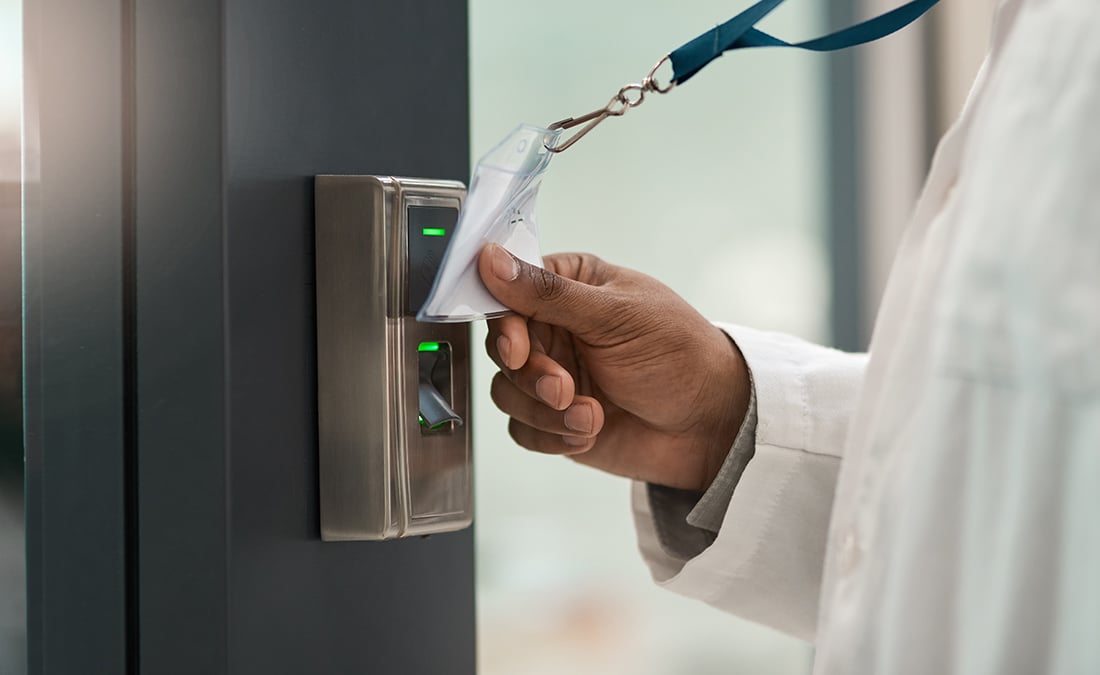
Access Control Systems: Door controllers, readers, credential databases, and management platforms can control access to sensitive physical spaces. Integrated access control therefore requires both physical and digital safeguards. Protecting the management platform and the network supporting it is just as important as selecting appropriate readers and credentials.
Intercom and Paging Systems: IP-connected communication platforms can depend on the same enterprise networks used by other critical technologies. Authentication, configuration, software maintenance, and network placement should therefore be considered as part of their deployment.
Building Systems: HVAC controls, environmental sensors, and other operational technologies may introduce additional connections between facilities and IT environments. Integrations between these technologies can increase operational efficiency, but they also make visibility into network architecture increasingly important.
Emergency Notification Platforms: Because these systems communicate critical information, protecting their availability and integrity should be part of a broader cyber physical security strategy.
The objective is not to treat every connected device as an imminent threat. It is to recognize that each device has a place in the organization's risk model and should be managed accordingly.
Building an Integrated Physical and Cyber Security Strategy
Organizations asking how to integrate physical and cyber security should begin with governance and architecture rather than individual products. A practical strategy can be built around seven steps:
- Create an asset inventory. Identify every physical security and facility system connected to the network, including cameras, access controllers, communications platforms, sensors, servers, management software, and related devices. Record ownership, location, software or firmware versions, network connections, and support status where possible.
- Assess risk. Evaluate cybersecurity exposure, firmware and software status, authentication practices, configuration, connectivity, and network segmentation for each system. Prioritize technologies based on both the likelihood of compromise and the operational consequences of disruption.
- Align governance. Establish clear responsibilities between IT, cybersecurity, physical security, facilities, and other stakeholders. Define who owns configuration, updates, monitoring, incident escalation, and replacement decisions. Governance should remain clear even when multiple vendors or service providers support the environment.
- Strengthen network architecture. Design appropriate segmentation for physical security technologies rather than placing devices indiscriminately on a flat network. A resilient network infrastructure is a fundamental component of converged security systems.
- Integrate monitoring. Give appropriate security and IT teams visibility into physical system availability, network behavior, alerts, and device health. Centralized visibility can make it easier to distinguish routine operational problems from activity that warrants further investigation.
- Coordinate incident response. Develop procedures for events that may cross the physical and cyber domains, including defined escalation paths and responsibilities. Plans should identify who needs to be involved when an incident affects physical access, network availability, communications, surveillance, or multiple systems simultaneously.
- Manage the technology lifecycle. Establish processes for firmware updates, software patches, configuration reviews, support status, and eventual device replacement. Legacy equipment that can no longer be securely maintained should be identified before it becomes an overlooked dependency.
Together, these practices help turn individual technologies into a more manageable unified security infrastructure. They also give organizations a repeatable framework for evaluating future security investments instead of addressing each new system in isolation.
How Integrated Security Reduces Incident Response Time
A major operational advantage of integrated physical and cyber security is the ability to give decision-makers a more complete picture of an incident.
Consider an access control event. In a disconnected environment, security personnel may need to identify the relevant door, determine the time of the event, locate corresponding surveillance footage, and manually coordinate with IT or facilities. When systems are appropriately integrated, an access event can help direct personnel toward the relevant camera or information more quickly.
The same principle can apply to emergency communication systems. Information from access control, surveillance, communications, and other connected technologies can provide additional context as authorized personnel assess an incident and determine the appropriate response.
Unified monitoring also helps IT and security teams correlate unusual network activity with physical events or device behavior. For example, an unexpected loss of connectivity affecting several security devices may warrant both a technical investigation and an assessment of the affected physical areas. Rather than treating those issues as unrelated, teams can examine them within the same operational context.
This shared visibility is particularly valuable across large facilities and multi-site organizations, where the personnel investigating an event may not be physically located at the affected property.
The result is not simply more data. It is better context for identifying problems, coordinating teams, and making informed decisions when time matters.
Integrated Security for Key Enterprise Verticals
Cyber physical security for enterprise environments must account for the operating requirements of each organization. The technology may be similar across facilities, but risks, workflows, users, and priorities can differ significantly.
Education: Schools and higher education environments depend on networks that support administrative systems, classroom technology, communications, access control, surveillance, and safety systems. Integration helps these technologies operate as coordinated parts of the school environment. Clear system ownership is especially important when district IT personnel, administrators, facilities teams, and security stakeholders share responsibility for connected technologies.
Government: Municipal and government facilities may require physical access accountability, operational continuity, secure communications, and visibility across multiple buildings or sites. Coordinating cyber and physical systems can provide a more consistent security layer and help stakeholders manage technology across distributed facilities.
Healthcare and Assisted Living: Connected facilities can combine sensitive information systems with access control, surveillance, communications, and building technologies, making strong network architecture and system management essential. Security planning must account for environments that operate continuously and depend on reliable communications.
Logistics and Warehousing: Large facilities, high volumes of employees and contractors, controlled entrances, surveillance systems, and connected operational technology create a complex enterprise security ecosystem. Multi-site operators also need consistent visibility and management practices across locations.
Commercial and Property Management: Organizations may need to protect tenant or business data while controlling physical access and monitoring multiple properties. Integrated systems can help security and property teams maintain visibility without treating each technology as a separate operational island.
Explore the industries we serve to learn how integrated technology requirements vary across different environments.
Common Mistakes Organizations Make When Converging Physical and Cyber Security
One of the most common mistakes is treating convergence exclusively as an IT project. Physical and cyber security integration is an organizational change involving technology, governance, processes, people, and accountability.
Another mistake is starting with new tools before understanding existing assets. Legacy cameras, controllers, servers, communications devices, and management platforms should be inventoried and evaluated before they are incorporated into a modern connected environment. Otherwise, organizations may build new infrastructure around devices that are difficult to update, poorly documented, or approaching the end of manufacturer support.
Organizations can also create unnecessary exposure by assuming a physical security product is automatically protected simply because it was professionally installed. Cybersecurity responsibilities such as network architecture, authentication, patching, monitoring, and lifecycle management still need clear ownership.
Other problems include deploying new devices without appropriate network segmentation and maintaining entirely separate procurement processes for physical security and cybersecurity. These practices can lead to incompatible requirements, duplicated investments, or security considerations being introduced too late in a project.
Successful convergence requires organizations to define governance first, understand their existing environment, establish shared security requirements, and then select technologies that support the intended architecture.
How Eastern DataComm Approaches Integrated Physical and Cyber Security Projects
With more than 35 years of systems integration experience, Eastern DataComm helps organizations bring physical security, communications, cybersecurity, and enterprise infrastructure together as a coordinated technology ecosystem.
Our approach begins with understanding each organization's facilities, existing infrastructure, operational workflows, security priorities, and long-term goals. We then design solutions that can bring access control, video surveillance, communications, networking, emergency notification, and cybersecurity together where appropriate.
That broader perspective is important because successful integration depends on more than choosing individual products. Network capacity, device placement, system interoperability, cybersecurity requirements, communications workflows, and future scalability can all influence how well a solution performs after deployment.
From system design and installation through integration and ongoing support, Eastern DataComm works with IT, facilities, security, and organizational stakeholders to help reduce technology silos and build a more cohesive security environment. Our team serves education, government, commercial, logistics, property management, and other organizations across the Eastern Seaboard.
Learn more about Eastern DataComm and our approach to integrated safety, security, communications, and infrastructure solutions.
Ready to evaluate your organization's physical security and cybersecurity strategy? Schedule a consultation with Eastern DataComm.