Case Study: Park Ridge (NJ) School District

District Implements Leading-Edge Communication And Emergency Notification Systems With Help From Eastern DataComm.

The Park Ridge School District comprises three schools with more than 1,200 students from pre-kindergarten through grade 12.

Events like Superstorm Sandy and the Sandy Hook Elementary School shooting were shocking demonstrations of the need for reliable emergency notification and communications systems.

After months of research and investigation, the New Jersey School Board Association’s (NJSBA) School Security Task Force made several recommendations, including the development of redundant communications and multifunction notification systems that integrate with local police and emergency responders.

The Park Ridge School District then worked steadfastly to implement and enhance their phone system as well as their communication and emergency notification technologies, relying on the expertise of the Eastern DataComm team to strategize and execute against this goal.

“We first started working with Eastern DataComm to update our phone system more than 15 years ago, and we’ve been working with them on upgrades ever since,” said Bob Wright, Business Administrator for the Park Ridge Board of Education. “They are very reliable, and they can do a lot of different things for us. It’s very handy to have someone like that as a vendor.”

Improving Communications

District officials first contacted Eastern DataComm to discuss replacing an on-premises PBX phone system that was no longer meeting their needs. The aging analog system did not support basic features such as voicemail, and phones could only be placed in common areas such as the main office and the teacher’s lounge. Infrastructure issues made it cost-prohibitive to wire buildings for classroom phones.

Eastern DataComm recommended a Mitel Voice-over-IP (VoIP) system that delivers far more flexible communications. Fiber trunk cabling can support multiple users and devices, making it possible to put phones in every classroom without running individual cables for each phone.

Integrated Systems

The fact that the phone system operates over an IP network has allowed the district to integrate paging and school intercom system applications that improve emergency notification capabilities in all three of their school buildings. All phones have a built-in interface that allows teachers, administrators, and staffers to use a telephone handset to page someone or make building-wide announcements.

“It has been a very good system,” said Wright. “We’ve had very few interruptions in service over the years, and the system is very easy to understand and use. Sometimes with Voice-over-IP, there can be issues with latency where you’ll actually hear yourself speaking through the line, but they’ve done a very good job of eliminating that. It sounds just like you’re talking through a wired phone line.”

An Advanced Emergency Notification System: LENS

School officials were excited to learn that more advanced security features could operate on top of the newly upgraded phone system including an advanced school safety system.

“Using the phone system that we already had, we could install this system that could provide real-time information to police and other designated contacts in the district. We went through a couple of presentations and found that we really liked this product.”

The product that impressed Park Ridge School District officials most was Eastern DataComm’s Lockdown Emergency Notification System (LENS). The system uses a proprietary controller to link the Mitel phone system with other features across the IP network including:

  • School intercom systems
  • Alarms
  • Strobe lights
  • LED signboards

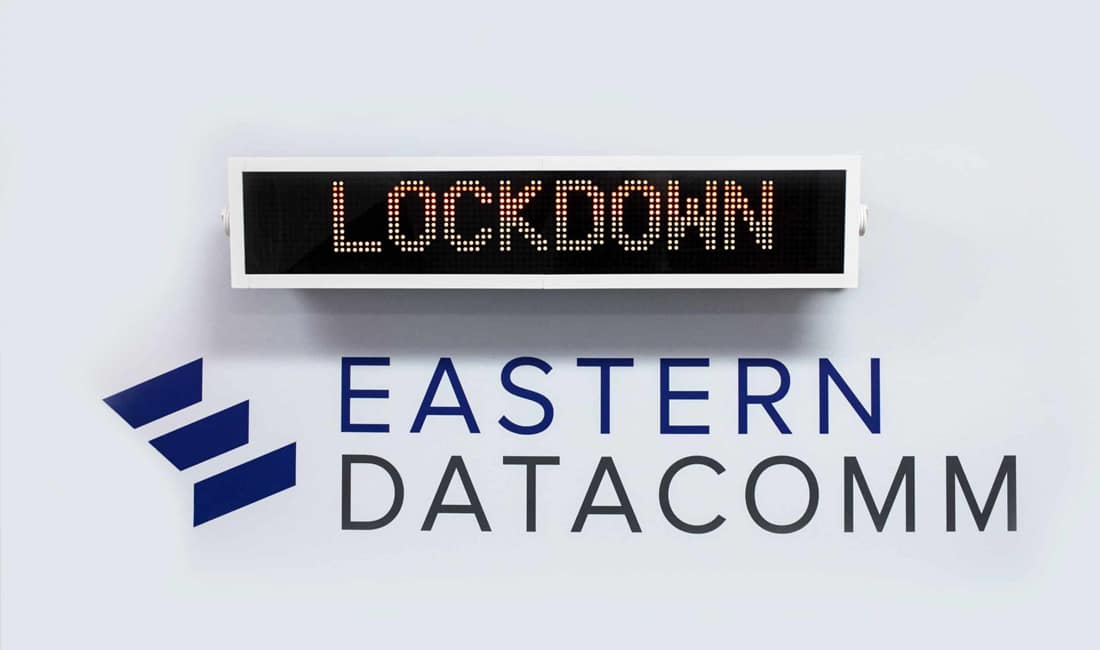
LENS allows teachers, staff, or administrators to quickly begin lockdown, evacuation, active shooter alerts, or shelter-in-place procedures. The LENS Solution can be initiated from any school phone or any of the activation buttons installed in common areas.

Once activated, the system initiates screen-pop alerts on phones throughout all school buildings and the Board of Education office, along with intercom audio messages, strobe lights, and LED sign board messages. A wireless radio component ensures that the notification reaches all outdoor spaces, including parking lots and sports fields.

An emergency notification also triggers automatic calls to 911, police, and fire departments.

Time is of the essence in an emergency, and LENS allows teachers, staff, or administrators to quickly initiate lockdown, evacuation, or shelter-in-place procedures. LENS can be activated from any school phone or from any of the several “stopper” buttons installed in common areas.

LENS brings all of these processes together to provide a comprehensive, seamless approach to emergency notification that is as rapid and effective as possible.

“People can now initiate a lockdown regardless of where they are in the building, whereas before you would have had to go to a designated area,” said Wright. “When we run drills, I get both a text message and a phone call — and it happens in the instant that something is triggered. We’ve been using it now for several months and it’s been working great.”

A Diagnostic And Consultative Partner For Your Safety And Communications Technology Needs

Wright has come to expect great solutions from Eastern DataComm.

“It’s been a very good relationship… The products are very good and their service is great. If you do have an issue, they will respond to you same day — which is almost unheard of, especially in the telecommunications industry.”

And what truly sets Eastern DataComm apart from others in our field is that we become your school physical security consulting partner utilizing our comprehensive diagnostic, collaborative, and consultative approach to safety and communications solutions.

Connect With Eastern DataComm

Eastern DataComm has the expertise to help keep your community connected and protected.

Schedule your complimentary School Safety Consultation with our Safety & Communications Advisors today by calling 888-902-4091 or emailing us at [email protected].

Our Approach: How Eastern DataComm Is Transforming The Way Our Customers Leverage Safety And Communications Technology

Eastern DataComm provides schools, businesses, and municipalities nationwide with end-to-end solutions that are the right fit for their ever-evolving safety and communications needs.

We have over 30 years of experience designing, installing, and maintaining safety and communications solutions for hundreds of our customers in the education, government, and business sectors.

Whether you’re exploring:

Eastern DataComm has the expertise to help keep your community connected and protected.

But what truly sets us apart from others in our field is our comprehensive diagnostic, collaborative, and consultative approach to safety and communications solutions.

More Than A Vendor: A Partner That Tailors Your Safety And Communications Solutions

The U.S. Department of Homeland Security Guide for Preventing and Protecting Against Gun Violence notes that each school building and its population is unique and the solutions selected to address the safety need of each environment should reflect this.

And at Eastern DataComm, we’ve been designing and adapting our clients’ school safety systems and mass notification systems to serve those unique needs for over three decades.

Our many years of experience have shown us that designing and implementing safety and communications technology is never a one-size-fits-all process. To find success and greater security for your school district, business, or municipality, you need more than a technology vendor. You need a true partner. That’s exactly the commitment our team has made to each and every one of our customers.

Right from our initial consultation and onward, we take the time to connect with you – unearthing and fully understanding the challenges and pain points that you face when tasked with safeguarding your community. We endeavor to get to know your district’s unique strengths and areas of need. This consultative, diagnostic approach allows us to define specific solutions that will work best for you and your goals.

Collaborative, Comprehensive Safety And Communications Solutions

One key part of our consultative and diagnostic approach is connecting with you to move through a comprehensive Safety and Communications Audit. As part of this process, we ask questions about your school environment, current technology, and what you need your safety and security solutions to achieve for you. Most importantly, we listen. Paying careful attention to the details our customers provide enhances our ability to deliver

We explore potential improvements you could make to enhance your safety, communications, and physical security technology for your school district, business, or municipality. We look to define what changes can be made to improve how you keep your community connected and protected.

As we move through the audit, we look to uncover areas where you could enhance your current safety and communications hardware or equipment to improve functionality and ease of use. In cases where your current technology is defunct, inefficient, or not designed for user-friendliness, we are happy to draw upon our years of experience and expertise to recommend alternatives as upgrades or replacements to improve your safety and communication practices. What is central to our process is ensuring that we provide you with the information and education you need on safety and communications technology options to make the most informed decision to safeguard your community. If we find that you’re following all recommended best practices in a particular area, we highlight that finding as part of our audit report and conversation to follow, commending your efforts and commitment to ensuring the safety of your community. We will continue to provide you with the latest education and informational resources to support your current and future decision-making processes for selecting the right-fit solutions as your safety needs evolve and so too does the landscape of technological options.

And while our consultative and diagnostic process is comprehensive, the one thing you won’t find in the process is a batch of cookie-cutter, one-size-fits-all technology “packages”.

Our clarity, support, transparency, and personalization are just some of the reasons our clients trust us with their safety and communications technology solutions.

What Our Clients Say About Collaborating With EDC

“It really is the total package. They have the right equipment. They have a great team, each with their own area of expertise. They say they’re going to do something in a certain amount of time, and they do it within that time. Whenever we have had a problem, even if it isn’t their responsibility, they have helped us. I would highly recommend Eastern DataComm.” – Executive Director, St. Joseph’s School for the Blind

Connect With Our Team To Put The Eastern DataComm Approach To Work For You

To experience the Eastern DataComm difference for yourself, book your Complimentary Safety and Communications Consultation here.

What To Look For When Selecting Your Access Control System

Does your current access control system need an upgrade? Are you thinking about bringing this technology to your school district, business, or municipality?

Here are three key areas to evaluate whether you’re considering installing or upgrading your access control system.

Do You Need A Way To Improve Daily Operations Or Automate Intruder Prevention?

Do any of these situations sound familiar?

  • Your staff is checking IDs by hand each morning
  • You’re still using locked file cabinets to protect sensitive information from unwanted eyes
  • You’re manually controlling who enters the building and when they do so

If any of these apply to your school district, business, or municipality, chances are that you want an even safer, more efficient, and more effective mode of knowing (and controlling) who’s allowed into buildings and on your grounds. Automating your school’s safety through access control technology not only improves the daily flow of people into and out of your building, but it also reduces the likelihood of human error by taking staff out of the manual operations that technology can do more efficiently. And that means a safer district for students, faculty, staff, and visitors.

When you’re considering whether to install or upgrade your access control system, it’s important to evaluate your day-to-day operations that could benefit from such changes and the added level of safety and security those changes would bring.

Some potential safety features that can be provided by an access control system include:

Swipe Card And Card Reader Technologies

Swipe card readers prevent unauthorized entrance by adding a layer of security to entryways. Eastern DataComm specializes in installing new swipe card systems and providing customers with existing systems the upgrades they need to ensure the highest level of access control and physical security possible.

Request To Exit Systems (REX)

Eastern DataComm offers both motion detection that releases the door when it senses motion and an exit button that releases the door when pressed. When using magnetic locks in your access control system, a request to exit button is required in case of emergencies. In emergency situations, it will disable the magnet’s locking power and allow for exit through that door.

Door Position Indicators And Magnetic Locks

Door position indicators and magnetic locks allow for controlled access and notification of potential security risks by using a system of doors, magnets, locks, and indicators to show if a door is open or closed, which could indicate the presence of an intruder.

Does Your Access Control System Integrate With An Emergency Response Notification System?

Another key consideration is how adding or enhancing an access control system can keep your district safe in the event of a fire, intruder, lockdown, or other urgent situation.

In cases like these, you’ll want to ensure your building’s fire escape plan and emergency lockdown procedures are not in opposition to one another.

And restricting access to certain areas in the event of an emergency or lockdown situation becomes faster, easier, and more effective when you have an access control system with technology that integrates with your emergency notification system.

At Eastern DataComm, our Lockdown and Emergency Notification System – LENS + OPTICS – integrates seamlessly with the access control systems we install and maintain for customers.

LENS (Lockdown Emergency Notification System) is a comprehensive notification platform that integrates with a school’s phone and paging/intercom systems. Once activated, communication is rapid and automated, including pre-recorded announcements over the PA system, activation of LED beacons and signboards, calls to cell phones and desk phones, PC pop-ups, emails, text messages, and pre-recorded calls to police.

To cover remote areas outside of the building, Eastern DataComm takes measures like installing wireless-enabled speakers and LED beacons to ensure complete coverage over the entire school grounds. Additionally, video surveillance can also be incorporated with LENS, which can quickly help law enforcement and first responders pinpoint the location of the identified threat.

LENS+OPTICS, coupled with access control, allows for restricting access to certain parts of buildings and grounds during emergency situations. Integration with other aspects of access control including Request To Exit Systems, Swipe Card Systems, and Door Position Indicators provide added information regarding a potential intruder and increase safety measures in the event of a lockdown.

To ensure that your LENS solution is running optimally, OPTICS, our continuous monitoring services, keeps eyes on your lockdown and emergency notification system so you don’t lose focus on your school’s safety.

This means our team at Eastern DataComm can create a comprehensive emergency notification system combined with access control, leading to further physical on-premises safety and security.

Do You Know What To Look For In Your Access Control Partner?

Finally, in addition to considering how access control can make your daily operations more streamlined, you’ll want to be sure that you have the right team on your side for planning, installing, and maintaining the system. When you work with our Safety and Communications Advisors and Technicians at Eastern DataComm, you can rest assured that you have the right technology and support resources in place to safeguard your school, business, or municipality community in the event of an emergency or lockdown Eastern DataComm has served hundreds of schools, businesses, and municipalities with customized technology solutions tailored to their unique needs and priorities. We not only offer seamless installation and unparalleled maintenance support, but we’re also happy to provide our customers with actionable insights stemming from our collective expertise in emergency notification, creating solutions that ensure ongoing safety and security.

Connect With Eastern DataComm

To learn more about how our team can support you as you install or upgrade your access control and emergency response technology, contact us at [email protected] for a complimentary consultation.

Is Your Emergency Notification System Working for You? Here’s How to Tell

School and government administrators have had an overwhelming volume and variety of unprecedented issues to handle these last two years. Not only has COVID-19 altered the physical and psychological landscape of schools, but there has also been an increase in serious incidents such as multi-victim homicides being perpetrated in educational facilities across the country. These frightening incidents have led many decision-makers in both education and government to explore the potential for emergency notification systems as a tool that enables rapid communication to first-responders who can mitigate damage and loss of life.

These emergency communications systems are typically initiated as soon as a school or building goes into lockdown. They allow administrators to communicate with emergency responders outside of the building to bring about a safer resolution to the incident whenever possible.

To help ensure the safety of our children at school, administrators are making strides to put strong safeguards in place that can help protect their communities, starting with a robust emergency alert system.

Three Main Features an Emergency Alert System Must Have

An emergency alert system, also called an emergency notification system, is a safety and communication solution designed to quickly broadcast emergency alerts and notify the proper channels, including police, students, and administrators inside and outside of the building. These notifications, along with a variety of other warning features, get the word out as quickly as possible. For example, they give instructions to those inside the building on whether they should evacuate or shelter in place.

However, every emergency notification system is not created equal. Here are a few features your school or municipality building’s emergency alert system must have in order to save lives.

The 20-Second Rule

The first 20 seconds of an emergency situation are undoubtedly the most critical. Your emergency alert system should be able to be activated from anywhere inside your building so that you aren’t wasting precious seconds in transit to a panic button that’s locked in an office or across the hall.

Fully Automated

Once an alert is triggered, your emergency notification system should be fully automated. The last thing you want is to expend your resources and time doing things that could be handled by technology – removing the opportunity for human error. The best emergency alert solutions can do everything themselves, from the initial active shooter or lockdown alert to deliver pre-recorded emergency notifications to law enforcement and first responders. These notifications include everything from texts and computer pop-ups to audio and visual notifications for students, faculty and staff that are visually or hearing impaired both within the school buildings themselves.

Complete Campus Coverage

With many schools getting larger and more geographically spread out, it’s never been more important for an emergency notification system to be able to cover the entire school grounds. That means inside AND outside school buildings. Places like athletic fields and parking lots can often be overlooked, but also need to be included in the coverage plans.

LENS+OPTICS Delivers Safety and Peace of Mind

A safe school environment is an essential component of what conditions empower effective learning. When students feel unsafe, they are more likely to engage in risky behaviors and score notably lower on standardized tests. Over the last few years, the percentage of children who feel safe at school has declined, and concerns from both parents and children tend to be at their highest immediately following a high-profile school shooting.

Investing in an emergency notification system reassures parents and students that the safety of your school campus is top priority. The Lockdown Emergency Notification System (LENS) Solution from Eastern DataComm is a comprehensive system that offers improved overall communication during a lockdown or incident. Coupled with OPTICS, Eastern DataComm’s continuous monitoring service, you can rest easy knowing that the technology you have in place is ready to respond when it is needed most.

What to expect with LENS + OPTICS

Our LENS+ OPTICS can be integrated with a school district’s current communication system, thanks to the expertise of our safety and communications technicians. From there, the LENS Solution can be activated by pressing a lockdown button, dialing a code from an on-premise phone, or even activating from a smartphone application.

Once activated, the system plays an automated pre-recorded announcement over the school’s existing paging system, as well as around the perimeter of the grounds. It reaches external areas like sports fields and portable school classrooms. Audio and visual alerts like strobes and LED signboards are installed to ensure loud areas like the auditorium and cafeteria are adequately covered.

After the initial warning, automated calls with a pre-recorded lockdown message are sent to first responders like the local police and other key administrators throughout the district like the superintendent, principal, and school security staff. Notifications also include PC screen pop-ups, emails, and text messages about the lockdown event.

OPTICS, which continuously monitors components that affect LENS to ensure it is always running optimally. In the event of a crisis, LENS+ OPTICS is the force that provides those in charge of ensuring the safety of their school campus with the ability to handle any critical situation as best as possible.

Want to learn more about how it works? You can explore the details of our LENS Solution here.

Why Partner with Eastern DataComm?

Eastern DataComm developed LENS + OPTICS after working closely with state officials, local police, and other school safety experts. The sole focus of our work has been to create a solution that can expedite communication, allowing for quick action in response to a threat on school or municipality grounds.

From design, to set-up, to testing, to monitoring, we’ll be with you every step of the way to ensure that your chosen solution works for the unique safety needs that define your campus.

Work with Eastern DataComm to Deploy LENS + OPTICS as Your Emergency Notification System

Eastern DataComm has been working with hundreds of school districts for over 30 years to assist them with improving safety and communications through leveraging technology. Our continued goal has been to offer reassurance to students, faculty, and staff that they will be able to respond as quickly as possible in the event of an emergency.

Contact us today to learn more about our comprehensive communication systems, and to discuss with our team of safety advisors what solutions might be best for your school’s needs.

6 Reasons to Upgrade Your Business Phone System

Businesses replace their desktop PCs about every five years. Mobile devices are replaced more frequently, especially for companies that allow employee-owned devices, because many consumers upgrade their smartphones and tablets as soon as they qualify for carrier discounts.

Yet many organizations tend to cling to old phone systems for 10 to 20 years. To give you a sense of how old that technology is, the iPhone was introduced 10 years ago, and the founders of Google purchased the google.com domain 20 years ago.

Why don’t organizations upgrade or replace their phone systems? In many cases, the business value of a new phone system is grossly underestimated. If the old phone system still works, there’s no sense of urgency to replace it. Or is there?

Here are six reasons why you should consider upgrading from a legacy phone system to a leading Voice over IP (VoIP) platform.

1) A New Phone System Provides Cost Savings

This is the slam dunk of a selling point for a new VoIP business phone system. A VoIP system eliminates the need to maintain separate voice and data networks and can help reduce telecom costs. With a cloud-based voice system, you can choose the features you want and pay for the service as a monthly subscription, with minimal upfront investment.

2) Valuable New Features

Today’s VoIP platforms give users access to conference calling, call presence, call routing, “find me, follow me” and many other features through an intuitive interface. All of this functionality can boost productivity and enhance customer service.

3) Application Integration

Unified communications platforms allow users to instant message, schedule and hold virtual meetings, and share files from their desk phone or softphone. Customer relationship management and other business applications, such as SalesForce, AMS 360 and NetSuite, can also be integrated with the phone system to streamline workflows.

4) Mobility Issues Resolved With New Phone System

With today’s VoIP phone systems, calls can be automatically forwarded to a mobile device, where the user can access the same tools and services they would find on their desk phone. This is far more efficient and reliable than expecting a caller to leave a message and wait for the recipient to retrieve the message and return the call.

5) New Business Phone Systems Offer Simple Scalability

As your business grows in terms of personnel and remote locations, a new phone system built on a VoIP framework makes it easy to add users, offices, devices, numbers, services and capacity without reinventing the wheel.

6) Elimination of Obsolete Technology

Old phone systems may still work, but the technology will eventually fail. When that happens, good luck finding parts and someone to make the repairs. Repairing outdated technology is a slow, expensive process, and every minute of downtime will cost you money. Invest in a new phone system now before the old system breaks down.

Why the Right Expertise Matters

Anyone can buy or sell a phone system. Choosing the right system for your organization and getting that system to do what you need it to do is a different story. That requires collaboration with data networking and communications experts. What features do you need? Would a cloud-based or on-premises system make more sense? Will your infrastructure support a new system? How will you keep your data secure?

Eastern DataComm will walk you through the planning, design, deployment, adoption and support phases of your phone system implementation, answering these and other questions to help you maximize ROI.

Let us show you how a new business phone system can help you reduce costs and do business better.

8 Factors to Consider When Implementing a Cloud Phone System

In a previous post, we discussed why more organizations are moving their phone systems to the cloud and what to look for in a cloud phone system. More than cost savings, a cloud phone system offers more control and flexibility, simpler management, the ability to add or remove users and services as needed, access to advanced features and applications, and built-in redundancy and disaster recovery.

Despite the benefits, adopting a cloud phone system is not a risk-free proposition. Implementing and using a cloud service is relatively simple, but aligning a cloud phone system with business operations and goals to maximize ROI is a complex process that requires a well-defined plan.

Here are eight factors to consider when moving your phone system to the cloud.

  1. User Experience. What applications and features do users need to become more productive? What are their priorities? Do different groups of users need different tools and services? Engage employees throughout the process to ensure the solution you choose is a good fit.
  2. Long-Term, Strategic Planning. Most organizations use a cloud phone system with other applications and services from multiple vendors. In addition to an implementation plan, there needs to be a roadmap in place to ensure disparate platforms can be integrated and performance can be holistically managed.
  3. Technology Evaluation. It’s tempting to choose the cheapest solution or even the one that seems easiest to use. However, cloud phone solutions must be evaluated based on business and communications requirements. This will ensure the system you choose has your must-have features, as well as valuable features you may choose to add down the road.
  4. A Phased Migration. As we mentioned in the previous post, you don’t have to move everything to the cloud at once. Migrating to a cloud-based phone system in phases allows you to move small groups of users and/or services to the cloud and gradually increase as you work out the kinks with minimal disruption.
  5. Assessment and Testing. What is the current state of the user experience and performance? What will the minimum benchmark be after implementation of a cloud phone system? Will your IT environment be ready to support phone features in the cloud today and in the future? Assess and test before, during and after deployment as needs evolve.
  6. Performance and Quality Monitoring. Proactively troubleshooting and addressing issues will help you avoid disruption to business operations and the user experience. Data from a variety of sources will need to be collected and correlated to maintain high levels of performance and quality.
  7. Application Integration. Users must be able to access all applications in a cloud phone system through a single interface. Otherwise, you’re asking for inefficiency and management complexity that can negate some cloud benefits. Make sure the applications you choose can integrate with other platforms.
  8. Security, Compliance and Business Continuity. A cloud provider should be able to prove to you that your data and applications will be secure and minimum compliance requirements will be met. The provider should also have a documented business continuity plan in case of an emergency.

Do not underestimate the skills and resources required to migrate to the cloud and meet ROI and productivity expectations. In most cases, this is not a do-it-yourself project, and it’s never a learn-as-you-go project.

Eastern DataComm can provide the expert guidance you need to successfully implement cloud solutions. Let us help you assess your existing infrastructure, develop a migration plan, and evaluate solutions to take full advantage of the benefits and minimize risk.

LENS Customization Meets School District’s Unique Safety Requirements

In the wake of the horrific 2018 school shooting at Marjory Stoneman Douglas High School in Parkland, Florida, a Federal Commission on Safety was established to research and recommend best practice solutions to improve school safety. As part of its final report, the commission recommended a multilayered approach to physical security that addresses the needs of diverse student populations, including students with disabilities.

That’s a recommendation that resonated with officials at the Berkeley Heights (NJ) Public School District.

The district comprises six schools serving approximately 2,500 students in pre-kindergarten through grade 12. Governor Livingston High School is well known throughout the region for its award-winning inclusive education program for deaf, hard of hearing and cognitively impaired students.

The safety of those students was a high priority when the district embarked on a project to improve its emergency notification system in 2019. Officials quickly discovered that longtime technology provider Eastern DataComm could provide the ideal solution.

Meeting Special Needs

Our team at Eastern DataComm, which has been supporting the district’s Mitel phone system for many years, showed officials how its proven Lockdown and Emergency Notification System (LENS) could be integrated with the phone system to boost security across the district’s six school buildings. Best of all, the system could easily be customized to meet the unique requirements of its hearing-impaired population.

In a recent case study, Mike Skara, the technology coordinator for Berkeley Heights Schools, noted that most notification systems are highly reliant on horns, loudspeakers and public address notifications to warn students, teachers and staff of an emergency. The district would need a system that featured more visual alerts for students in the high school’s deaf and hard-of-hearing program.

Our engineering specialists at Eastern DataComm accounted for such scenarios when originally designing the LENS solution. In addition to generating emergency notifications over phones, intercoms and loudspeakers, the system integrates strobe lights and LED signage to deliver visual cues. Accommodating Berkeley Heights’ special requirements only involved adding additional signs and lights in the high school’s classrooms and common areas such as the cafeteria.

Multiple Methods of Communication

EDC further customized the system to integrate with the school district’s Google G Suite collection of cloud-based tools that enable digital communication and collaboration between students and teachers. That creates additional avenues for delivering emergency notifications with alerts transmitted by phone, text and email. Additionally, notifications can be designated for distinct audiences in different buildings.

There was no guesswork with the LENS solution, either. Eastern DataComm has implemented LENS in hundreds of K-12 schools and municipalities in the New York/New Jersey Tri-State area.

“It’s a well-designed solution that was already being widely used, so it was pretty clear it would check off all the boxes for us,” said Skara. “Plus, Eastern DataComm was able to customize it for our particular needs.”

School safety and security solutions must account for the needs of all students, and provide for multiple modes of communication with administrators, staff, teachers, first responders and law enforcement. Eastern DataComm’s LENS solution prepares schools to respond rapidly in any emergency.

Is your school best prepared to handle the worst? Get the conversation started by contacting us by phone (201)-457-3311 or email [email protected] today.

7 Ways Unified Communications Benefits State and Local Government

Many government agencies at the state and local level still rely upon legacy phone systems or Centrex-type services leased from carriers. These older systems are difficult to manage, expensive to maintain, and lack many of the features of a modern communications platform. Designed when most workers sat at desks throughout the day, they are incapable of supporting today’s remote and mobile workers.

Unified Communications for Public Services

Legacy phone systems aren’t just frustrating for government employees — they make it difficult for agencies to meet the expectations of their constituents. As consumers we have grown accustomed to seamless communication via a variety of channels, including phone, email, text and online chat. We are used to having ready access to accurate, up-to-date information. We demand this level of service from businesses, and expect nothing less from government agencies.

An IP-based unified communications (UC) platform can help state and local governments enhance both their operations and the services they deliver. UC brings together voice, video and collaboration tools in a single interface, eliminating communications silos and enabling seamless transition from one channel to another. “Presence” lets users know whether someone is available and their preferred means of communication, eliminating phone tag. UC solutions can also be wirelessly integrated with other applications and data to streamline workflows and provide one-click access to powerful communications tools.

Unified Communications for Government: 7 Benefits

  1. UC makes it easier for constituents to reach the right person to answer their questions and solve their problems. UC supports personalized call handling and routing, as well as auto-attendant and contact center capabilities.
  2. IP communications creates a common platform across multiple sites and agencies. (ex: Borough Hall and the police department, DPW, town library and/or the fire department.) By enabling real-time collaboration, it helps boost productivity, speed response times and facilitate decision-making.
  3. Many government agencies are using telework programs to reduce costs, provide for continuity of operations, and give employees greater flexibility. A UC system can be extended to teleworkers so they remain connected and have access to the tools they need when working remotely.
  4. Many municipal administrators and other key personnel are frequently out of the office. The mobile device integration enabled by a modern UC platform gives them secure access to the communications environment — anytime, anywhere. With mobility, administrators can make and receive phone calls just as if they are at their desks.
  5. Because IP communications leverages the data network for voice calls, it is more cost-efficient and easier to manage than legacy platforms. Web-based administration tools simplify moves, adds and changes across multiple locations. Teams can access comprehensive features and functionality without draining vital resources. With a short amount of training, most anyone can easily access this information and make these changes – saving costs with a limited IT team that many municipalities have.
  6. Whether on-premises or in the cloud, today’s UC platforms have a fault-tolerant and redundant architecture that helps ensure continuous availability for disaster recovery.
  7. An IP communications system can also be integrated with physical security systems. UC becomes the communications platform for emergency notification systems. With the LENS solution, a municipality can notify everyone inside and outside the building as well as other sites that an emergency event has commenced. The UC platform enables the solution to call the local police, 911 and key administrators simultaneously as well.

The ShoreTel Unified Communications platform is a proven solution that connects people and information while reducing total cost of ownership. It is highly secure and reliable, with failover capabilities that are essential to government agencies for both day-to-day operations and during emergency situations.  You can ensure high quality services with enterprise-class availability to meet the demands of your employees and constituents.

At Eastern DataComm, we are proud of our history serving the communications needs of state and local governments.

Let us show you how we can enhance the quality of your communications infrastructure to help you increase efficiency and better serve your constituents.  Contact us today!

How Communication and Automation Improve School and Office Safety

school safety

Tragedies involving violence at our schools and places of work have made safety a top-of-mind issue across the country. Many states, counties and municipalities have passed or are considering legislation that mandates increased security measures and greater cooperation between schools, law enforcement and the community at large. Public- and private-sector organizations are dedicating budget dollars to security technologies and training programs designed to enhance school safety.

Traditionally, schools and larger office spaces have focused on perimeter security such as video surveillance and access controls to prevent intruders from entering their facilities. While these tools are beneficial, experts agree that crisis planning and staff training in lockdown procedures play a more critical role in safety. Lockdown drills are recommended best practices that enable schools and offices to test security protocols and give staff an opportunity to practice procedures. With proper training, human beings can assess situations, make quick decisions and communicate vital information that saves lives.

But the human element can also be a weak link in security. Training and drills can at best simulate an emergency. In an actual crisis it’s difficult to predict how human beings will react.

School Safety Case Study

Delaware Valley Regional High School District recognized this weakness and sought an automated emergency notification solution that could be activated from virtually anywhere on campus. The district asked Eastern DataComm to implement our Lockdown and Emergency Notification System (LENS), which promptly notifies teachers, students and staff of an emergency situation and to immediately initiate lockdown procedures.

Old and Outdated Paging System

Delaware Valley had a 30-year-old PBX and a poorly functioning PA system that had been extended over time. The project involved implementing a ShoreTel Unified Communications system, revamping the PA system and integrating both with the L.E.N.S. Entering a code on any ShoreTel phone triggers an automated system that calls 911, alerts administrative staff and causes a series of prerecorded announcements to be played over the PA system.

Adding Strobe Lights and Display Messages

Because audible announcements cannot always be heard, the system also activates strobe lights, and the district is planning to add digital signage that will display emergency messages. Wireless transmitters using the same FM bands as first responders extend the system to outdoor facilities, parking lots and other areas where wiring is cost-prohibitive.

Launch Emergency Procedures From a Mobile App

The emergency procedures can also be initiated via a mobile app installed on smartphones. This enables administrators to utilize the L.E.N.S. remotely, and allows teachers to summons help in the event of an emergency on a sports field or other outdoor location.

In adopting LENS by Eastern DataComm, Delaware Valley has been able to meet best practices set by the New Jersey State Police for rapid response in a crisis. The New Jersey School Security Task Force, among other authorities, have prioritized the implementation of emergency communications systems as a means of improving school safety. The automation enabled by the LENS speeds response times and reduces confusion, panic and misinformation by ensuring that information is disseminated swiftly and clearly.

No school or office wants to be the site of the next tragedy. Let us show you how the LENS can help you enhance safety through automated emergency response and notifications. Contact us today to discuss your emergency notification needs.

Critical Pieces of a School Emergency Notification System

Multiple modes of communication is the first critical piece when implementing a school emergency notification system. In an emergency situation, seconds count. Panic and confusion are deadly. Everyone in danger must be alerted as quickly as possible, and advised whether to lockdown, shelter in place or evacuate.

Key Components of a School Emergency Notification System

A fully functional emergency notification system consists of multiple interconnected components designed to disseminate alerts quickly and efficiently. Schools must implement multiple communication channels to ensure that everyone—students, staff, visitors, and emergency responders—receives timely and accurate alerts.

Essential Elements of an Effective System:

  • Visual Alerts – Digital signage, LED beacons, and desktop notifications that provide clear, immediate warnings in classrooms, hallways, and outdoor spaces.
  • Audible Alerts – PA systems, pre-recorded announcements, and sirens that ensure messages are heard across campus, even in noisy environments.
  • Text and Mobile Alerts – SMS, push notifications, and automated emails that reach staff, parents, and emergency responders instantly.
  • Integration with Access Control – Systems that lock doors automatically, alert security teams, and restrict access to unauthorized individuals.
  • Emergency Response Coordination – Direct integration with local police, fire departments, and first responders, ensuring real-time situational awareness.

Having multiple layers of communication prevents reliance on a single notification method that could fail due to technical issues, power outages, or network disruptions.

Study Shows Importance of Multiple Modes of Communication

That’s one of the takeaways from the New Jersey School Security Task Force Report and Recommendations, published in July 2015. The two years study into school security found the importance of rapid and clear communication in emergency response.  Critical information should be distributed “without delay in an understandable format,” ideally using multiple modes of communication.

Many Schools Are Not Prepared For Emergency Situations

Unfortunately, many schools are ill-equipped for active shooter situations, school lockdowns and emergency messages via mass notification. For example, announcements made over a PA system may not be heard in noisy areas, playgrounds, parking lots, sports fields or outdoor areas. Visitors to a public school building may be unaware of an emergency. As a result, emergency notification systems need both visual clues and audible alerts to ensure that staff members, students and visitors are alerted.

The Role of Mass Notification Systems in School Safety

Mass notification systems for schools are designed to deliver emergency messages quickly across various platforms, ensuring no one is left uninformed during a crisis.

Why Mass Notification Systems Are Essential

  • Faster Emergency Response – Automated alerts reduce delays caused by manual notifications, allowing for immediate action.
  • Multi-Location Alerts – Schools often have multiple buildings, outdoor areas, and off-campus facilities that require different notification strategies. A mass notification system ensures the right message reaches the right location.
  • Customizable Messaging – Different emergencies require specific instructions (e.g., lockdown, shelter-in-place, or evacuation), preventing panic and confusion.
  • Redundant Communication Paths – Ensures that if one communication method fails, others remain operational, safeguarding continuity in crisis situations.

By implementing a robust mass notification system, schools can enhance safety in schools by ensuring consistent, reliable, and wide-reaching emergency communication.

School Emergency Notification System Case Study

This approach to emergency communications is especially important for individuals with disabilities. That’s why St. Joseph’s School for the Blind selected the Lockdown and Emergency Notification System (LENS) from Eastern DataComm. Because of visual impairments and multiple disabilities, St. John’s students needed clear warnings as quickly as possible if an emergency were to occur.

Lockdown and Emergency Notification System by Eastern DataComm

LENS uses a proprietary controller integrated with the school’s PA system, strobe lights, wireless speakers and digital signage. Activate the system by dialing a code on any phone or pressing a lockdown button placed in key areas throughout the building. The emergency notifications spread throughout the campus in seconds. School administrators and first responders (local police, 911 and the Chief of Police) are also contacted simultaneously and automatically.

The Importance of Access Control in Emergency Situations

An emergency notification system for schools should integrate with access control to improve security response and protect students and staff.

How Access Control Enhances School Emergency Response

  • Automated Door Locking – During a lockdown or emergency, the system can automatically lock all doors, preventing intruders from moving through the building.
  • Real-Time Entry Monitoring – Schools can track who enters and exits in real-time, ensuring unauthorized individuals cannot access restricted areas.
  • Immediate Notification to Security Personnel – If an access breach occurs, alerts are sent instantly to security teams, allowing them to respond before threats escalate.
  • Visitor Management Integration – Ensures that temporary visitors, contractors, and delivery personnel are included in emergency communications, preventing gaps in security.
  • Remote Access Control – Administrators can lock or unlock doors from a centralized dashboard, improving response time in rapidly evolving emergencies.

Integrating access control for schools with mass notification systems allows schools to respond to threats dynamically, reducing risks and ensuring swift security actions.

Hearing Audible Alerts

Hearing audible alerts throughout campus was of particular importance to St. Joseph’s. Eastern DataComm replaced the school’s aging PA system with a modern, less expensive solution. Additional speakers were installed to ensure there were no “dead spots” where announcements could not be heard. In addition, since the ShoreTel IP phone system has built in, handsfree intercom capabilities, the new paging only needed to make overhead announcements.

A key component of  LENS is Eastern DataComm’s expertise. The Eastern DataComm team analyzed the school’s facilities, designed the system and developed a detailed project plan. The ShoreTel phone system and other major components were installed and tested over winter break to minimize disruption. St. Joseph’s had planned to leave its old phone system online in case of problems, but the cutover went without a hitch. As a result, the Paramus School  in Paramus, NJ now has a flexible, highly reliable phone system with advanced features and crisp audio.

Emergency Notification System Compliance & Best Practices

Schools must follow specific safety and security guidelines to ensure their emergency notification systems are effective, reliable, and legally compliant.

Best Practices for School Emergency Notification Compliance

  • State & Local Safety Standards – Many school districts require compliance with state-specific safety guidelines for mass notification systems. Schools should review district safety policies and ensure their system meets emergency communication mandates.
  • Regular System Testing & Drills – Schools should conduct monthly system tests and biannual emergency drills to confirm that alerts are reaching all intended recipients.
  • Data Privacy & Security Compliance – Schools must ensure that contact information used for emergency alerts is stored securely and follows data protection laws.
  • Accessible Notifications for All Students & Staff – Schools must ensure that alerts accommodate individuals with disabilities, including visual and hearing impairments, by using both audio and visual alert methods.
  • Failover & Backup Systems – Redundant notification methods must be in place so that messages still go out if a primary system fails due to power outages or network issues.

By following these best practices, schools can ensure their emergency notification system is reliable, compliant, and effective in protecting everyone on campus.

Strengthening School Safety with the Right Security Partner

Creating a safe learning environment requires integrated technology, strategic planning, and expert support.

At Eastern DataComm, we provide:

  • Custom Emergency Notification Systems – Ensuring instant, multi-channel communication.
  • Access Control for Schools – Enhancing security by automating lockdowns and restricting access.
  • Mass Notification Systems for Schools – Seamlessly integrated with PA systems, digital signage, and mobile alerts.
  • VoIP & Paging Solutions – Ensuring clear, school-wide communication during emergencies.

Although designed especially for school safety, LENS can help any organization increase safety through integrated communication and automation features.

Take proactive steps to improve safety and security in schools. Contact Eastern DataComm for a demonstration of this unique solution.

Proud Member Of

Society of Communications Technology Consultants International SCTC logo
New Jersey School Boards Association NJSBA logo
Educational Services Commission of New Jersey ESCNJ logo
Monmouth Ocean Educational Services Commission MOESC logo
Connecticut Association of Public School Superintendents CAPSS logo